
Table of Contents
- Michigan Unemployment Insurance at a Glance
- How Much You Can Get in Michigan in 2026
- Who Qualifies in Michigan
- Filing Your Michigan Claim, Step by Step
- Weekly Certification in Michigan
- How Long Michigan Benefits Last
- Manufacturing Layoffs, Union Dispatch, and Michigan Claims
- If Michigan Denies Your Claim: Appeals in 30 Days
- Fixing the Wage Record: Michigan Investigations That Move Money
- Training Programs and Reemployment Services in Michigan
- Payments and the Michigan 1099-G
- A Short Michigan Checklist Before You File
- A Biweekly Certification Example, Line by Line
- Taxes on Michigan Unemployment Benefits
Michigan Unemployment Insurance at a Glance
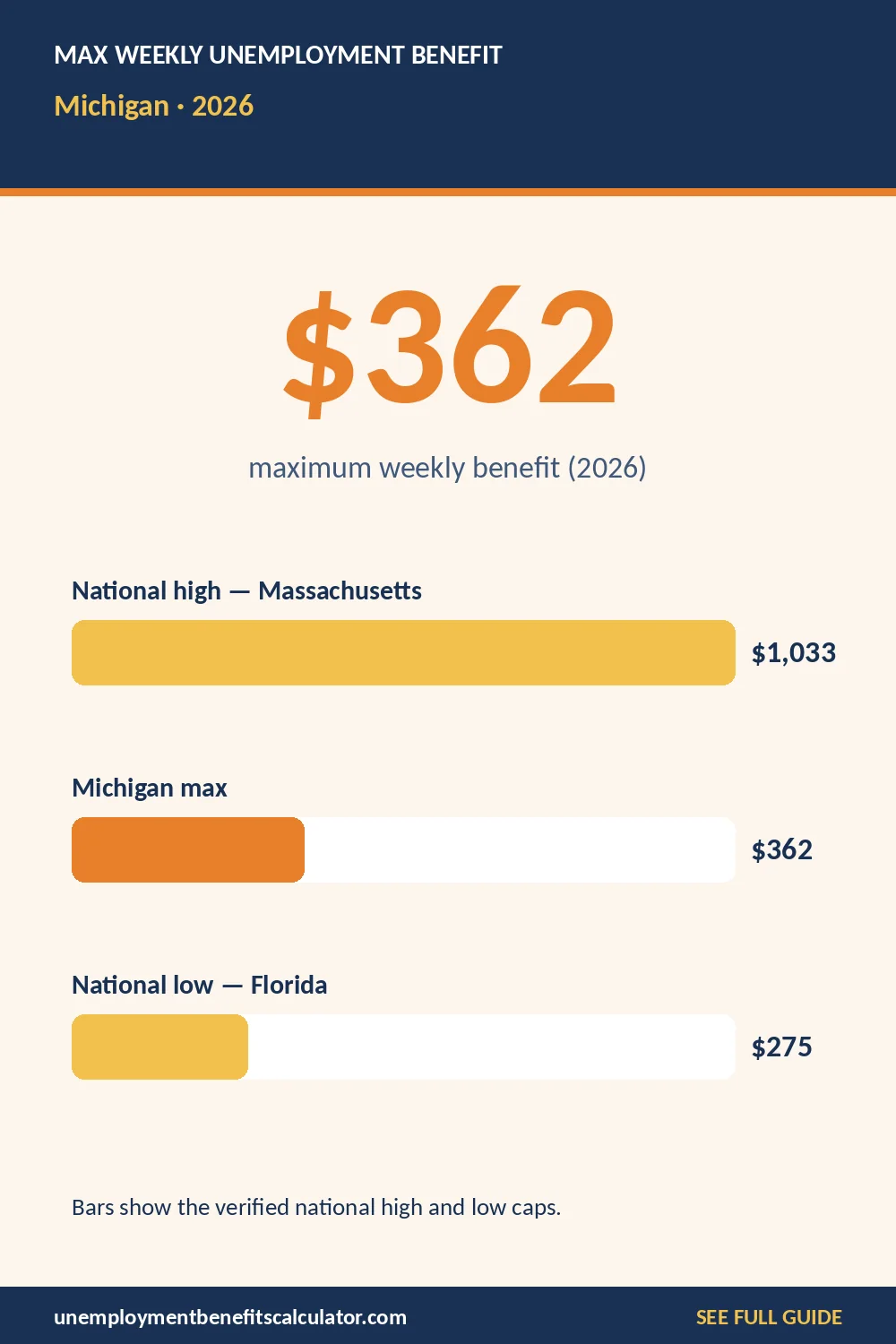
Michigan's Unemployment Insurance Agency pays a maximum of $362 per week for a standard 20 weeks. A formula that adds a small dependent allowance on top of the base rate.
Claims run through the UIA's online Michigan Web Account Manager, the work search asks for two weekly activities. The state's rock-solid manufacturing rhythm means claim patterns arrive in plant-level waves more often than individual separations.

Michigan's numbers sit in the middle of the national table. Mid-range weekly amounts, a 20-week runway that beats the Southeast's 12-week standard. An appeal window that is genuinely long.
This guide covers the full 2026 picture for Michigan workers, from the amount formula through the tax treatment. The state-specific details that generic guides skip.
For context against neighbors, Michigan pays more per week than Ohio's minimum-heavy structure for mid-wage workers but caps lower than Illinois. The state comparison guide frames it, and the Michigan unemployment calculator estimates your weekly amount before you file.
How Much You Can Get in Michigan in 2026
Michigan computes your weekly benefit as 4.1% of your highest quarter of base period wages. Plus a small addition for qualifying dependents. The total capped at $362 per week and a minimum in the high $80s.
The 4.1% figure makes the math unusually transparent: multiply your best quarter by 0.041. You have your base weekly rate before dependents.
| Item | Michigan 2026 value |
|---|---|
| Maximum weekly benefit | $362 |
| Minimum weekly benefit | In the high $80s |
| Dependent addition | A few dollars per dependent, up to five |
| Standard duration | 20 weeks |
| Waiting week | One week (unpaid) for most claims |
| Work search requirement | 2 work search activities per week |
Reaching the $362 ceiling takes roughly $8,800 in your best quarter, which full-time workers near the state's median wage clear. The dependent addition is modest but stacks meaningfully for larger families. The dependents allowance guide explains how states structure and verify the additions.
Michigan's 20-week duration sits between the 26-week standard and the 12-week Southern baseline. Extended Benefits can extend it only when federal triggers activate in severe downturns. The Extended Benefits guide covers the mechanics, and the base period guide explains the wage window feeding the 4.1% formula.
Who Qualifies in Michigan
The monetary test requires base period earnings at. Above a statutory floor with wages in at least two quarters, enough to produce a rate above the minimum. Michigan also applies an "active quarter" requirement.
Wages in the quarter outside your two high quarters that anchor recent attachment to the workforce. Workers who fail it should check whether wages from adjacent quarters or another state complete the record. The monetary eligibility guide covers the anatomy.
Separation rules follow the national structure. Layoffs and hour reductions qualify cleanly, quits need good cause attributable to the employer or compelling personal circumstances. Discharges shift the burden to the employer to prove misconduct connected with the work.
Michigan's misconduct standard excludes good-faith errors and simple inadequacy, a line the fired-for-cause guide illustrates with case patterns. The good cause guide covers the quit side.
Weekly eligibility requires ability, availability, and two work search activities per week, registered in the state's job system. Michigan samples activity records and cross-matches employer payroll quarterly.
The same documentation discipline applies as everywhere: dated logs, gross earnings, week-earned timing. The availability guide explains the standard, and the log format guide shows records that survive review.
Filing Your Michigan Claim, Step by Step
File the week your employment ends, because Michigan pays nothing for weeks before your application. The Web Account Manager portal is the primary channel, with a phone line for filers who need it. Before starting, gather:
- Social Security number and a driver license or state ID
- Employment history for the last 18 months, with each employer's legal name, mailing address, phone, and dates
- Your last pay stub showing gross wages
- Dependent information if you plan to claim the additions
- Banking details for direct deposit
The application captures your separation story and wage history, then issues your certification schedule. Michigan employers respond to claims at high rates, and conflicting accounts route into fact-finding with response deadlines measured in days.
Michigan posts processing information, and the U.S. Department of Labor's UI resources keep the official contact directory current.
Check the monetary determination against your own 4.1% math the day it arrives. Staffing-agency workers and employees of companies with multiple entities often see wages split across employer records.
Suppresses the high quarter until an investigation merges them. The recompute guide explains why the request must come early, and the first payment timeline guide sets expectations after filing.
Weekly Certification in Michigan
Michigan certifies every two weeks by default rather than weekly, a quirk that surprises claimants from other states. Each certification covers the two prior weeks, asking the standard battery for each.
Did you work, gross earnings, availability, and your work search activities. The biweekly rhythm makes accurate record-keeping more important, because two weeks of numbers ride on each filing.
Report gross earnings for each week separately, for the week earned, including tips and commissions. Michigan's partial formula reduces payments dollar for dollar above a modest allowance. Earnings at or above the weekly benefit zero that week.
With the $362 maximum, a $360 part-time week erases a check entirely. The disregard guide runs the scenarios. The certification reporting guide covers the week-earned mechanics that matter double in a biweekly system.
Missed certifications need backdating with a documented reason through the portal, and the missed deadline guide walks the repair. The certification questions guide previews the full screen. In Michigan asks about school attendance and retirement collections in addition to the standard battery.
How Long Michigan Benefits Last
Michigan pays up to 20 weeks inside a benefit year, with the one-week waiting period consuming the front edge. Zero-payment weeks caused by earnings count against the 20 in most cases. Means the partial-work arithmetic and the runway math are the same conversation in Michigan's mid-length system.
When benefits exhaust before employment resumes, Michigan's retraining programs and workforce services run through the state system. Federal Extended Benefits can activate in severe downturns. The exhaustion guide sequences the options.
Workers with wage history in another state can check the interstate claims guide to compare formulas. Matters for workers whose careers cross the Ohio and Indiana lines regularly.
Manufacturing Layoffs, Union Dispatch, and Michigan Claims
Michigan's claim calendar still runs on manufacturing rhythms, and plant-level events shape the paperwork. Large layoffs trigger WARN Act notices that belong in your claim file.
Documented advance notice interacts with your filing date and any severance timing. The severance guide and the bankruptcy guide cover the employer-side scenarios that reshape the first weeks of a claim.
Union members with recall rights face the dispatch-and-benefits interaction: Michigan accepts union dispatch as work search activity. The certifications still ask the able-and-available battery. The answers must match the dispatch rules.
The union member guide covers the interaction. The suitable work guide explains when a lower-paying rehire offer can be declined without penalty. Becomes a live question in every plant-rehire cycle.
Seasonal patterns across tourism-heavy northern Michigan create the between-seasons claim pattern. The availability questions and the base period timing interact. The seasonal workers guide covers the pattern, and the seasonal certification rules guide explains the school-year and resort-calendar edge cases.
If Michigan Denies Your Claim: Appeals in 30 Days
Michigan's determination states the decision and the reason. The appeal window is 30 calendar days from the mailing date, one of the more forgiving windows in the country.
First-level appeals go to an Administrative Law Judge hearing, by phone, with a written decision afterward. The longer window reduces panic-driven mistakes, but the record still decides the case, so assemble documents rather than arguments.
Michigan's ALJ hearings are more formal than most states' first-level reviews. The evidence rules are looser than a courtroom but structured: exhibits identified in advance carry more weight than improvisation.
The appeal guide and the hearing preparation guide cover the structure. The employer contest guide explains what the other side files.
Michigan-specific traps worth naming: biweekly certifications filed late because the rhythm surprised claimants. Dependent additions claimed without documentation, and net-versus-gross reporting errors. The application mistakes guide collects the checklist before filing rather than after.
Fixing the Wage Record: Michigan Investigations That Move Money
Michigan's 4.1% formula makes wage-record errors unusually easy to audit yourself: multiply your best quarter by 0.041. Compare the result to your determination. When the numbers diverge, the wage record is the suspect.
Michigan investigations fix the common failures: staffing-agency splits, bonuses posted in the wrong quarter. Wages filed under the wrong entity.
A merged record can raise the weekly amount for the entire benefit year. Is why the request belongs in week one, not month three.
The investigation packet is short: pay stubs covering the missing quarter, W-2s. A brief timeline of where the wages went. Michigan asks the employer to verify, then issues a redetermination that recalculates the claim.
Claims with stubs resolve in weeks; claims with memory resolve never. The recompute guide explains the freeze, and the WBA calculation guide shows what the corrected record should produce.
Two Michigan-specific patterns deserve a flag. Multi-entity employers in automotive supply chains report wages across subsidiaries.
Auto workers' records often span both hourly plants and salaried engineering arms of the same group. Both patterns merge cleanly with documentation, and the monetary eligibility guide explains how states count the merged result.
Training Programs and Reemployment Services in Michigan
Michigan's reemployment system ties benefits to services more explicitly than most states. The two weekly work search activities route claimants into the state's job-matching and career services. Claimants approved into retraining plans can have availability requirements adjusted while they train into growth occupations.
Approval happens before enrollment, and the sequence is the whole game: career center, plan, then certification changes. The school-while-claiming guide covers the logic.
Training also interacts with the 20-week budget. A claimant entering an approved program mid-claim effectively converts remaining weeks into funded training time. Often the highest-value use of the balance for workers in shrinking industries.
The benefit period guide shows the sequencing. The exhaustion guide covers the fallback when the balance runs out before the program completes.
Michigan's work sharing framework gives employers a formal alternative to layoffs. The state replacing a defined slice of reduced wages under friendlier math than the regular partial formula. Workers seeing plant slowdowns should raise it with management and the union hall together.
Enrollment runs at the employer level. The work sharing guide covers the mechanics.
Payments and the Michigan 1099-G
Michigan pays benefits by direct deposit or its state debit card. Deposits typically landing two to three business days after a processed biweekly certification.
Direct deposit avoids the card's fee edges, which the payment method guide maps. Bank changes belong between certification windows rather than inside a pending one.
The January 1099-G reports total benefits and elected federal withholding. Michigan's state tax layer lands on your April return because the state does not withhold weekly.
The tax guide covers both layers and the estimated-payment option. Claimants who later repay benefits should read the overpayment guide for the tax adjustments that interact with the same form.
A Short Michigan Checklist Before You File
Five checks fit Michigan's system: run the 4.1% self-audit against your best quarter before trusting the determination. Gather dependent documentation if claiming the additions.
Set calendar reminders for the biweekly certification rhythm so the two-week cycle never surprises you. Decide on federal withholding knowing it covers only the federal layer.
Calendar the 30-day appeal window the day any determination arrives. The application mistakes guide expands the list. In Michigan the biweekly rhythm is the trap that catches otherwise careful claimants every year.
Set the portal reminders the day your claim approves. Mirror the two-week log against the certification screen exactly as Rosa's example showed. The 20-week runway becomes what the state intended: a predictable bridge with no surprises buried in its calendar.
A Biweekly Certification Example, Line by Line
Michigan's biweekly rhythm makes one worked example worth more than paragraphs of advice. Suppose Rosa certifies on a Sunday covering the two prior weeks. Week one she worked 16 hours at $15, grossing $240.
Week two she worked 10 hours and grossed $150 plus a $60 reported-tip shift, totaling $210. Her weekly benefit is $362 with no dependents. Michigan's modest allowance means both weeks reduce dollar for dollar above it.
Rosa enters week one's gross as $240 and week two's as $210, in the correct boxes, for the correct weeks. The most common Michigan error lives exactly here: averaging the two weeks into one number. Misprices both and creates a mismatch with employer payroll.
The second error is net-versus-gross, which the certification reporting guide covers in detail. The third is timing, where a Friday paycheck covering the prior week belongs to the week earned, not the deposit date.
The biweekly rhythm also changes the audit trail. Two weeks of numbers ride on each filing, so a single sloppy certification doubles the cross-match surface. Michigan's payroll matching runs the same quarterly cycle as every state.
Rosa's protection is a two-column weekly log that mirrors the certification screen exactly. The certification questions guide previews every screen field so the log and the portal agree by construction. Claimants who build that habit in week one never think about the rhythm again.
Taxes on Michigan Unemployment Benefits
Michigan taxes unemployment benefits as state income in addition to the federal layer. The state does not withhold from weekly payments, so the state liability lands on your April return.
The optional 10% federal withholding during the claim covers only the federal piece. The 1099-G reports the totals each January.
A full 20-week run at the $362 maximum produces $7,240 of taxable income. Both tax layers price against it, which makes the mid-claim withholding decision worth a deliberate answer rather than a default. The unemployment tax guide covers both layers.
The estimated-payment option, the payment method guide explains how the weekly money arrives. The overpayment guide covers the repayment adjustments that interact with the same 1099-G when a redetermination recovers weeks.
Frequently Asked Questions
How much is unemployment in Michigan in 2026?
Michigan pays up to $362 per week, computed as 4.1 percent of your highest quarter of base period wages plus a small dependent addition, with a minimum in the high $80s. Reaching the ceiling takes roughly $8,800 in a single quarter.
How many weeks does Michigan unemployment pay?
Michigan pays up to 20 weeks within a benefit year, after an unpaid one-week waiting period. Zero-payment weeks caused by earnings count against the 20 in most cases, and Extended Benefits can extend the runway only in severe downturns.
How often do you certify for unemployment in Michigan?
Michigan certifies biweekly rather than weekly, so each certification covers two prior weeks and asks the work, earnings, availability, and work search questions for each week separately. Report gross earnings by week earned, because two weeks of numbers ride on every filing.
Does Michigan tax unemployment benefits?
Yes. Michigan applies state income tax to benefits in addition to federal tax, and the state does not withhold from weekly payments. The optional 10 percent federal withholding covers only the federal layer, so plan for Michigan's piece on your April return.
What are the work search requirements in Michigan?
Michigan requires two documented work search activities per week, registered in the state's job system. Union dispatch counts for members with recall rights, and the state samples activity records, so keep dated entries that match your certifications.
What is the deadline to appeal a Michigan unemployment denial?
Thirty calendar days from the mailing date, one of the longer windows nationally. Appeals go to an Administrative Law Judge hearing by phone, and the documentary record decides most cases, so assemble schedules, write-ups, and correspondence early.