
Table of Contents
- Ohio Unemployment Insurance at a Glance
- How Much You Can Get in Ohio in 2026
- Who Qualifies in Ohio
- Filing Your Ohio Claim, Step by Step
- Weekly Certification in Ohio
- How Long Ohio Benefits Last
- Part-Time Work and Partial Benefits in Ohio
- If Ohio Denies Your Claim: Appeals in 21 Days
- Fixing the Wage Record: Ohio Investigations That Move Money
- Manufacturing Layoffs, WARN Notices, and Ohio Claims
- Training Programs and Reemployment Services in Ohio
- A Short Ohio Checklist Before You File
- Payments and the Ohio 1099-G
- Taxes on Ohio Unemployment Benefits
Ohio Unemployment Insurance at a Glance
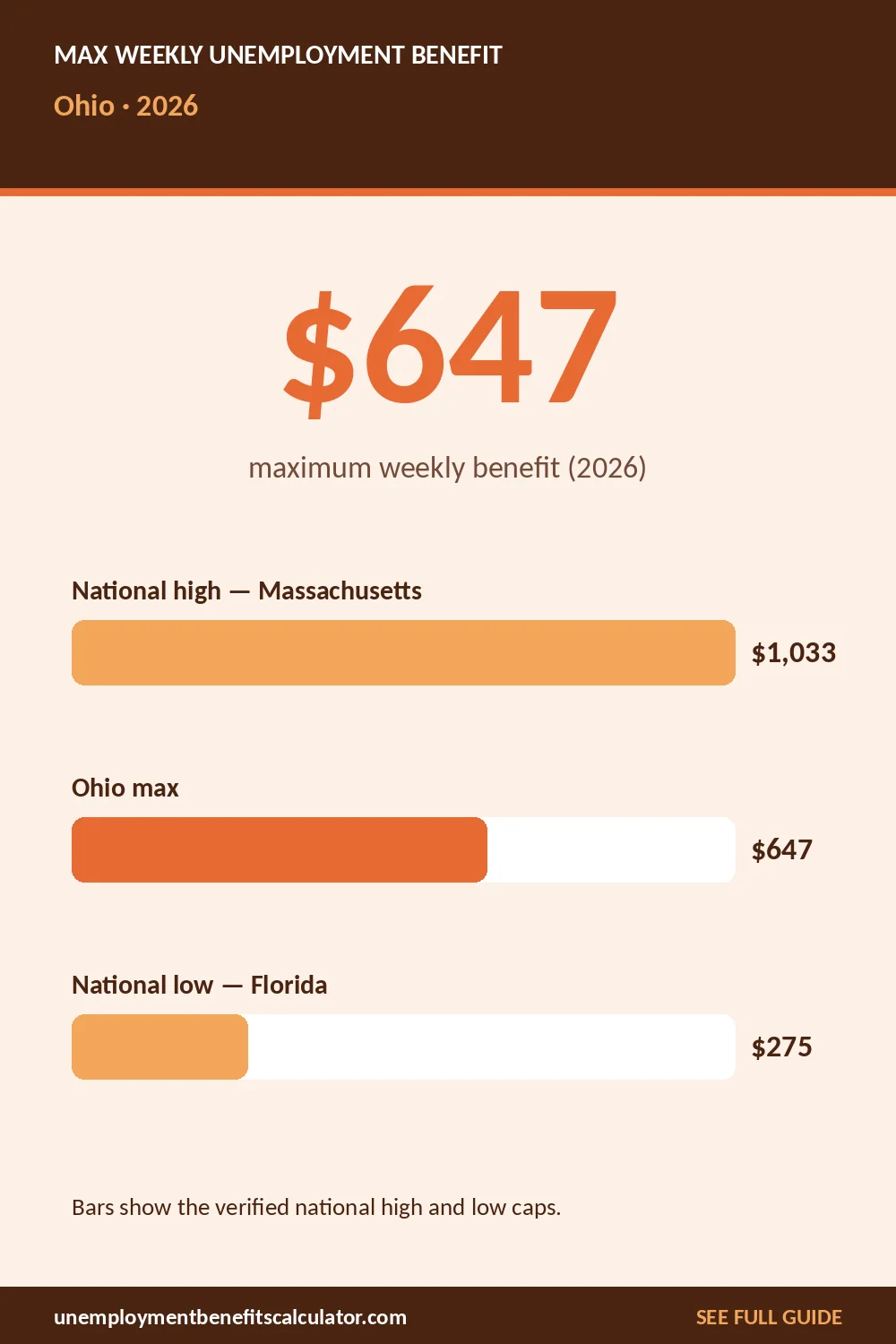
Ohio runs its unemployment program through the Ohio Department of Job and Family Services. Claims filed and managed through the state's online unemployment system. The program pays up to $647 per week for a standard 26 weeks.
One of the higher maximums in the Midwest. It balances that generosity with a dollar-for-dollar earnings reduction that makes part-time planning unusually important.

Ohio's claimant experience rewards precision: the weekly certification asks pointed questions about work. Earnings, the state's cross-match program is active, and the appeal windows run short.
This guide walks the full 2026 picture for Ohio workers: amounts, eligibility, the filing sequence, weekly certifications, part-time math, appeals. Taxes, with the state-specific details that generic guides skip.
For context, Ohio's weekly amounts sit above the national middle while its dollar-for-dollar partial rules sit at the strict end nationally. The state comparison guide frames both facts. The Ohio unemployment calculator estimates your weekly amount from your own wage history.
How Much You Can Get in Ohio in 2026
Ohio computes your weekly benefit from your base period wages with a minimum of $135. A maximum of $647 per week. The formula reads your two highest quarters rather than a single best quarter.
Smooths seasonal spikes and rewards steady employment more than single-quarter surges. Full-time workers at the state's median wage generally land well above the minimum. The $647 ceiling requires a strong two-quarter history.
| Item | Ohio 2026 value |
|---|---|
| Maximum weekly benefit | $647 |
| Minimum weekly benefit | $135 |
| Standard duration | 26 weeks |
| Waiting week | One week (unpaid) for most claims |
| Work search requirement | 2 reemployment activities per week |
| State tax on benefits | Yes (Ohio income tax applies) |
Ohio's $135 minimum is one of the higher minimums nationally. Means thin-but-real work histories still produce a meaningful weekly check rather than a token payment.
Workers whose wage history straddles the qualification line can read the monetary eligibility guide to see how states count the record. The minimum benefit comparison shows how Ohio's floor ranks.
Extended Benefits can extend the 26-week runway when federal triggers activate in severe downturns. Ohio also participates in the federal Short-Time Compensation framework.
Its own work-sharing rules let employers reduce hours across a unit with friendlier benefit math than the regular partial formula. The work sharing guide explains the program from both sides.
Who Qualifies in Ohio
The monetary test requires sufficient base period wages to produce a benefit above the minimum. Computed from your standard base period, the first four of the last five completed calendar quarters. Ohio's two-quarter smoothing means a weak most-recent quarter matters less than it does in high-quarter states.
Workers whose strong quarters sit further back often find Ohio's formula forgiving. The base period guide explains the window mechanics.
Separation law follows the national structure. Layoffs, hour reductions, and closures qualify cleanly. Quits need good cause attributable to the employment.
Ohio's precedent applies a plain "unworkable" standard that produces surprising wins for claimants with documented unsafe conditions or material contract breaches. Discharges put the burden on the employer to prove just cause under Ohio's definitions, which exclude isolated good-faith errors. The good cause guide and the fired-for-cause guide map both tests.
Weekly eligibility requires ability, availability, and two reemployment activities per week registered through the state's job-matching system. Ohio verifies activity on a sampling basis. The availability guide explains how school calendars, childcare constraints, and medical limitations interact with the able-and-available standard.
Filing Your Ohio Claim, Step by Step
File the week your employment ends, because Ohio pays nothing for weeks before your application date. The online system is the primary channel, with a phone option for filers who need it. Before starting, assemble:
- Social Security number and driver license or state ID
- Employment history for the last 18 months, with employer names, mailing addresses, phone numbers, and employment dates
- Your last pay stub with gross wages and year-to-date totals
- Your banking routing and account numbers for direct deposit
- Any separation paperwork, such as a layoff letter or WARN notice
The application captures your separation story and wage history, then assigns your weekly certification schedule. Your employer receives notice and can respond, and conflicting accounts produce fact-finding questionnaires with short deadlines.
Ohio posts current processing timelines on its site, and the U.S. Department of Labor's UI resources keep the official state directory current.
Read your monetary determination against your own pay stub math the day it arrives. Errors in employer wage reports are common, and the fix is a wage investigation requested with documentation.
The recompute guide explains why the request must come early. The weekly amount freezes for the benefit year once the claim establishes.
Weekly Certification in Ohio
Ohio certifies weekly, asking whether you worked, your gross earnings, whether you refused work, and your reemployment activities. The earnings answer is the one Ohio claimants get wrong most often. The state's dollar-for-dollar rule means every reported dollar moves the check by a full dollar until the week zeroes out.
The strict partial math deserves its own paragraph. Ohio applies essentially no earnings disregard: gross earnings reduce the weekly payment dollar for dollar. Any week where earnings meet or exceed your weekly benefit pays nothing.
A $500 claimant earning $200 gross receives $300. Earning $500 or more receives zero while the week still counts against the balance in most scenarios.
The disregard guide contrasts this with other states' formulas. The part-time rules guide covers the availability questions that ride along.
Certification precision matters more in Ohio than the national norm because the cross-match converts small understatements into overpayment demands at a dollar-for-dollar ratio. Report gross figures for the week earned, include tips, and log your two activities with dates and employer names. The certification reporting guide and the certification questions guide cover the full weekly screen.
How Long Ohio Benefits Last
Ohio pays up to 26 weeks inside a 52-week benefit year, with the one-week waiting period consuming the front edge. Because zero-payment weeks still count against the maximum in most cases, partial workers should treat the balance like a budget.
A week worked at full wages is a week of coverage spent. The arithmetic should make that trade deliberate rather than accidental.
When benefits exhaust before employment resumes, Ohio's reemployment services and training programs run through the state workforce system. Federal Extended Benefits can activate in severe downturns.
The exhaustion guide sequences realistic options. Workers with wage history in another state can check the interstate claims guide to see whether the neighboring state's formula would price the claim higher.
Part-Time Work and Partial Benefits in Ohio
Ohio's dollar-for-dollar rule makes it the state where hour planning pays the most. Because the credit is zero, there is no discount on any earned dollar. The optimal pattern for a partial worker is usually spreading hours thin across weeks rather than concentrating them.
Whenever the employer's schedule allows. A $500 claimant who earns $250 in each of two weeks keeps $500 total. The same 50 hours concentrated in one week costs a full zero-payment week.
The cliff interacts with holiday pay, PTO payouts. Bonus allocations in ways that surprise claimants. All of them count as earnings in their assigned weeks under Ohio's rules.
A $275 holiday-week payout can zero an otherwise light certification week. The lump-sum guide and the overtime and bonus guide cover the allocation logic. The vacation certification guide covers the related calendar questions.
Workers whose employers are considering formal slowdowns should ask about Ohio's work sharing program before the schedule cuts land. The program's math is friendlier than the regular partial formula and protects the 26-week balance differently. The Short-Time Compensation guide explains the enrollment requirements from the employer side.
If Ohio Denies Your Claim: Appeals in 21 Days
Ohio's determination letter states the decision and the reason. The appeal window is 21 calendar days from the mailing date. First-level appeals go to a hearing before the Unemployment Compensation Review Commission, held by phone, with a written decision afterward.
The commission's record decides the case, so assemble documents rather than arguments: schedules, write-ups, correspondence. Wage records all belong in the bundle.
Just cause is the battleground in most Ohio discharge cases, and the employer carries the burden of proving it. Isolated good-faith errors typically fall short of Ohio's just-cause standard. Claimants whose write-ups cite performance rather than deliberate rule-breaking should say exactly that.
The appeal guide and the hearing preparation guide cover the format. The employer contest guide explains what the other side files.
Ohio-specific traps worth naming: letting the fact-finding questionnaire deadline lapse, certifying before completing the required job-system registration. Reporting net rather than gross earnings, which is the single most common overpayment source in the state. The application mistakes guide collects the full checklist.
Fixing the Wage Record: Ohio Investigations That Move Money
Ohio's dollar-for-dollar partial rule gets the attention, but the wage record quietly moves more money. Employer quarterly reports carry errors, missed bonuses, misfiled quarters. Wages posted under the wrong state, and each error flows straight into Ohio's two-quarter formula.
A missing $3,000 quarter can drop a computed benefit by $50 to $100 per week. Fixed for the benefit year unless you catch it.
The fix runs through a wage investigation. Ohio's version rewards precision: submit pay stubs covering the missing quarter, W-2s. A short timeline of where the wages went.
The investigation asks the employer to verify, then issues a redetermination that recalculates the benefit from the corrected record. Claims with stubs resolve in weeks; claims with memory resolve never. The recompute guide explains the freeze rules that make the timing urgent.
Watch for two Ohio-specific wage patterns. First, staffing-agency workers often see wages split across multiple reporting entities. Depresses any single quarter's numbers until the investigations merge them.
Second, tipped and bonus-heavy payrolls in the hospitality corridor around Columbus. Cincinnati see bonuses posted in the wrong quarter entirely. Both patterns are correctable, and the WBA calculation guide shows what the corrected record should produce.
Manufacturing Layoffs, WARN Notices, and Ohio Claims
Ohio's manufacturing base makes plant-level layoffs a recurring claim pattern, and the paperwork differs from individual separations. Large reductions trigger WARN Act notices, 60-day advance warnings that belong in your claim file.
Documented advance notice interacts with your filing date and any severance timing. The bankruptcy guide and the severance guide cover the scenarios where the employer's finances shape the claim's first weeks.
Plant layoffs also produce the union-pattern claim questions: dispatch availability, recall rights, and seniority systems. Ohio accepts union dispatch as work search activity for workers with recall rights. The weekly certifications still ask the standard able-and-available battery.
The answers need to match the dispatch system's rules. The union member guide covers the interaction, and the availability guide explains the recall-right edge cases.
Rehire offers after a plant event deserve caution rather than reflex. Refusing a recall to your prior position can disqualify weeks, and the suitability analysis around lower-paying rehire offers is state-specific.
Ohio's suitable-work standard weighs wages against your prior rate and the claim's stage. The right answer depends on facts the suitable work guide lays out section by section.
Training Programs and Reemployment Services in Ohio
Ohio's reemployment system ties benefits to services more explicitly than most states. The two weekly reemployment activities route claimants into the state's job-matching and career services. Claimants approved into retraining plans can have their availability requirements adjusted while they train into growth occupations.
The approval happens before enrollment, and the sequence is the whole game: career center, plan, then certification changes. The school-while-claiming guide covers the approval logic in detail.
Training also interacts with the 26-week budget. A claimant entering an approved program mid-claim effectively converts remaining weeks into funded training time. Is often the highest-value use of the balance for workers in shrinking industries.
The benefit period guide shows the sequencing. The exhaustion guide covers the fallback options when the balance runs out before the program completes.
Federal layers close the Ohio picture. Extended Benefits can extend the runway when recession triggers activate. Disaster Unemployment Assistance can cover storm-affected workers after federal declarations, including the self-employed who normally fall outside the program.
The Extended Benefits guide explains the triggers. Claimants near exhaustion should read the claim reopening guide for the rules on returning to an old claim after a work attempt fails.
A Short Ohio Checklist Before You File
Five checks fit Ohio's system: verify your two highest quarters against pay stubs before relying on the estimate. Plan your part-time hours against the dollar-for-dollar rule rather than against hope. Register the two weekly activities from the first certification, decide on federal withholding knowing it covers only the federal layer.
Calendar the 21-day appeal window the day any determination arrives instead of filing it mentally for later. The application mistakes guide expands the list. In Ohio the checklist habit is worth more than in most states because the cross-match runs strict.
Payments and the Ohio 1099-G
Ohio pays weekly benefits by direct deposit. Its state debit card, typically two to three business days after a processed certification. Direct deposit is the cleaner option for claimants with accounts.
The payment method guide details the card's fee edges for those without. Bank changes belong between certification weeks, not during a pending one.
The January 1099-G reports total benefits and elected federal withholding. Ohio's state tax layer lands at return time because the state does not withhold weekly. The tax guide covers both layers and the estimated-payment math for claimants who skipped withholding.
The overpayment guide closes the loop on repayment adjustments that touch the same form. The final Ohio habit worth building: treat every certification like the audit sample is reading it.
In a dollar-for-dollar state the cross-match converts small errors into large invoices. Run the checklist above, file the first week, and the system's generosity finally reaches the people it was designed for.
Taxes on Ohio Unemployment Benefits
Ohio taxes unemployment benefits under its state income tax, in addition to the federal layer. Ohio does not withhold state tax from weekly payments, so the liability lands on your April return. The federal 10% withholding election during the claim covers only the federal piece, which claimants sometimes misread as covering everything.
The combined tax bill deserves a mid-claim estimate rather than an April surprise. A claimant at the $647 maximum for 26 weeks receives $16,822 of taxable income, and both layers apply to it. The unemployment tax guide covers the return lines and the estimated-payment option.
The payment method guide explains how the weekly money arrives. If a later redetermination recovers benefits, the overpayment guide covers the repayment and tax-offset mechanics that close the loop.
Frequently Asked Questions
How much is unemployment in Ohio in 2026?
Ohio pays between $135 and $647 per week, computed from your base period wages with the two highest quarters smoothing the result. The $135 minimum is one of the higher state minimums nationally, so thin-but-real work histories still produce a meaningful check.
How many weeks does Ohio unemployment pay?
Ohio pays up to 26 weeks within a 52-week benefit year, after an unpaid one-week waiting period. Zero-payment weeks caused by earnings generally count against the maximum, so part-time workers should plan hours against the 26-week budget.
Does Ohio tax unemployment benefits?
Yes. Ohio's state income tax applies to unemployment benefits in addition to federal tax. Ohio does not withhold state tax from weekly payments, and the optional 10 percent federal withholding covers only the federal layer, so estimate both pieces during the claim.
What are the work search requirements in Ohio?
Ohio requires two reemployment activities per week, registered through the state's job-matching system. The state samples activity records, so keep dated entries with employer names and contact methods for each week you certify.
Can I work part time and still get unemployment in Ohio?
Yes, but Ohio uses dollar-for-dollar reduction with essentially no earnings disregard. Gross earnings reduce the check one for one, and any week where earnings meet or exceed your weekly benefit amount pays nothing while still counting against the balance.
What is the deadline to appeal an Ohio unemployment denial?
Twenty-one calendar days from the mailing date of the determination. Appeals go to a phone hearing with the Unemployment Compensation Review Commission, and the documentary record usually decides the case, so file immediately and gather schedules and correspondence.