
Table of Contents
- North Carolina Unemployment at a Glance
- How Much You Can Get in North Carolina in 2026
- Who Qualifies in North Carolina
- Filing Your North Carolina Claim, Step by Step
- Weekly Certification in North Carolina
- How Long North Carolina Benefits Last
- Part-Time Work and Partial Benefits in North Carolina
- If North Carolina Denies Your Claim: Appeals in 15 Days
- Industry Notes: Banking, Biotech, and the Carolina Service Belt
- North Carolina Fact-Finding: The Short-Clock Exchange
- Work Sharing, Training, and Fallbacks in North Carolina
- Payments and the North Carolina 1099-G
- A Short North Carolina Checklist Before You File
- When North Carolina Recalculates: The Mid-Year Mechanics
- Taxes on North Carolina Unemployment Benefits
North Carolina Unemployment at a Glance
North Carolina's Division of Employment Security runs one of the leanest unemployment systems in the country: a maximum of $350 per week. A standard duration of 12 weeks when the state economy is healthy.
The state balances that with a genuinely simple filing process through the DES portal, no waiting week. A two-contact weekly work search that is lighter than most of the Southeast.

The combination of low amounts and short duration makes North Carolina a state where the first-week strategy matters more than anywhere else in the region. Weeks lost to late filing, missed certifications.
Avoidable fact-finding delays are proportionally enormous when the total runway is 12 checks. This guide covers the full 2026 picture for North Carolina workers, from amounts through taxes.
For national context, North Carolina pairs the shortest duration band with a mid-low weekly ceiling. The state comparison guide frames the contrast. The North Carolina unemployment calculator estimates your weekly amount from your wage history.
How Much You Can Get in North Carolina in 2026
North Carolina computes your weekly benefit from your base period wages using an average-weekly-wage formula. A minimum of $49 and a maximum of $350 per week. The formula replaces roughly half of your average weekly wage, subject to the ceiling.
Full-time workers at or above the state's median wage typically reach. Because the formula averages rather than reading a single best quarter, seasonal spikes matter less than steady work.
| Item | North Carolina 2026 value |
|---|---|
| Maximum weekly benefit | $350 |
| Minimum weekly benefit | $49 |
| Standard duration | 12 weeks, scaling up to as much as 20 by state unemployment rate |
| Waiting week | None (payable from the first week) |
| Work search requirement | 2 employer contacts per week |
| State tax on benefits | Yes (North Carolina income tax applies) |
Two features of that table shape every North Carolina claim. First, no waiting week means the first certification week is payable, which effectively adds a check that neighboring states deduct. Second, the 12-week baseline is the shortest standard runway in the country.
Extending only when the statewide unemployment rate climbs past statutory triggers. The Extended Benefits guide covers the federal layer for severe downturns.
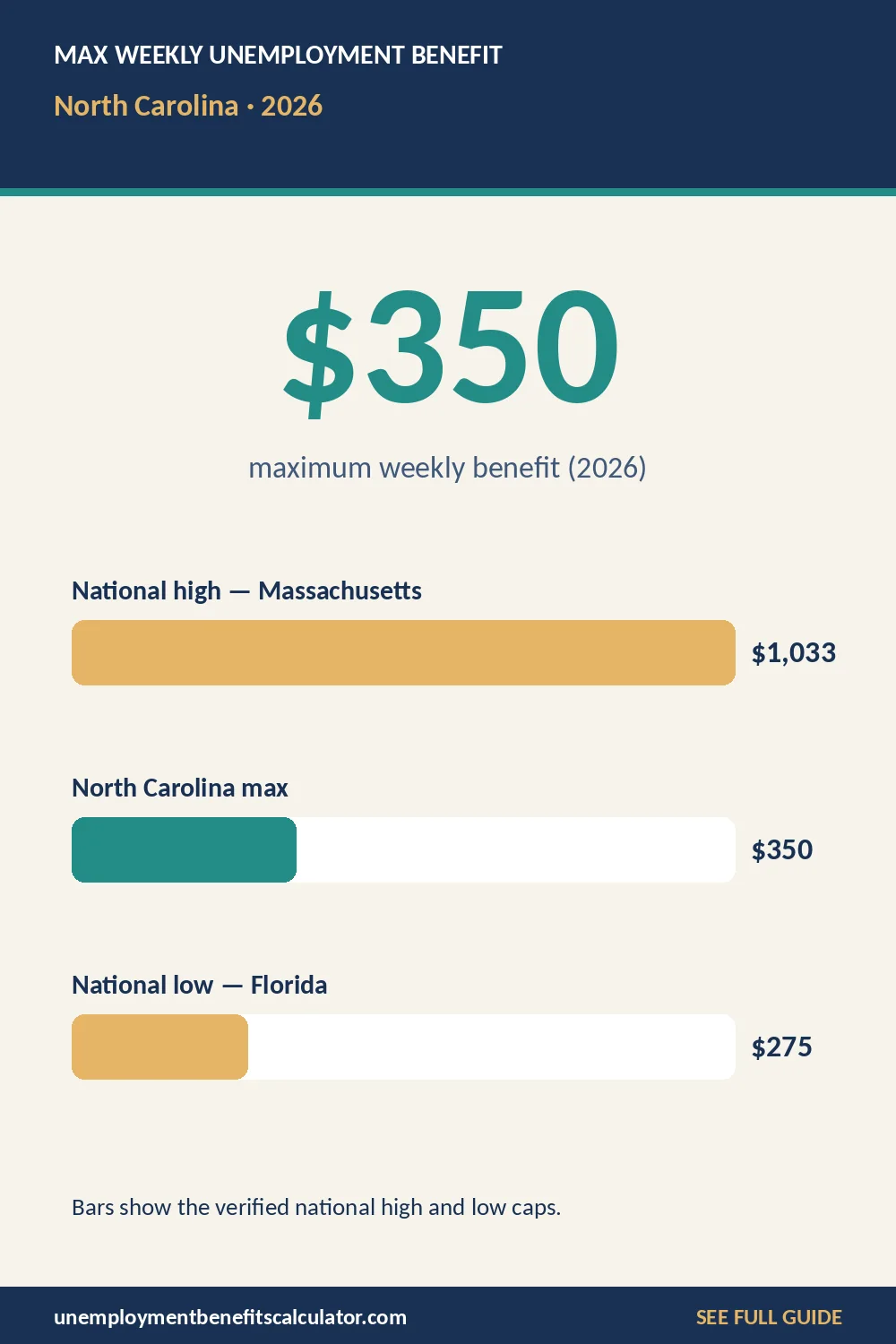
The $350 ceiling makes the wage record investigation more valuable than in most states. A missing quarter can move a claimant from near-maximum to far below it. The WBA calculation guide shows what the record should contain, and the monetary eligibility guide explains how states read quarters.
Who Qualifies in North Carolina
The monetary test requires base period wages sufficient to produce a weekly benefit above the $49 minimum. Spread across at least two quarters of the lookback window.
Workers with thin or irregular histories should check whether the base period window actually captures their best work. A one-quarter shift changes the calculation materially.
Separation rules follow the national architecture with North Carolina's employer-friendly tilt. Layoffs qualify cleanly, quits need good cause attributable to the employer or compelling personal necessity. Discharges require the employer to prove misconduct connected with the work.
North Carolina's misconduct standard is narrower than many claimants fear, but the state's adjudicators enforce documentation discipline on both sides. The good cause guide and the fired-for-cause guide map the evidence.
Weekly eligibility requires ability, availability, and two documented employer contacts per week. Registration in the state's job-matching system as part of the claim.
The two-contact standard is genuinely lighter than Georgia's three or Florida's five, but North Carolina samples records all the same. The availability guide covers the able-and-available standard.
Filing Your North Carolina Claim, Step by Step
File the week your employment ends, because North Carolina pays nothing for weeks before your application. With a 12-week runway each lost week is expensive.
The DES portal handles filing around the clock. Before starting, gather:
- Social Security number and a photo ID
- Employment history for the last 18 months with employer names, mailing addresses, phone numbers, and dates
- Your last pay stub with gross wages and year-to-date totals
- Banking details for direct deposit
- Any separation paperwork, such as a layoff letter or final write-up
The application walks through separation reasons and wage history, then issues your certification schedule. Employers receive notice and can respond, and conflicting accounts produce fact-finding questionnaires with short deadlines.
North Carolina posts processing information on its site, and the U.S. Department of Labor's UI program page keeps the official directory current.
Read the monetary determination against your own pay stub math immediately. With the benefit year freezing your weekly amount. Wage investigations filed early are the difference between a corrected claim and a year of underpayment.
The recompute guide explains the freeze mechanics. The first payment timeline guide sets expectations for the weeks between filing and the first deposit.
Weekly Certification in North Carolina
North Carolina certifies weekly, asking whether you worked, gross earnings, availability, and your two employer contacts. The certification drives each weekly payment.
The state's cross-match against employer payroll records runs on the same cycle as every state. Precision in the earnings answer prevents most downstream trouble.
Report gross figures for the week earned, including tips and commissions. Remember that North Carolina's partial formula reduces payments dollar for dollar with only a small earnings allowance.
Earnings that meet or exceed your weekly benefit zero the week while the week still counts against the 12-week balance in most cases. The disregard guide runs the arithmetic, and the certification reporting guide covers the weekly mechanics that keep cross-matches quiet.
Missed certifications need backdating requests with documented reasons, and North Carolina's repair windows run short. The missed deadline guide walks the process, and the certification questions guide previews the full weekly screen.
How Long North Carolina Benefits Last
North Carolina pays up to 12 weeks in normal conditions. Scaling toward 20 only when the statewide unemployment rate passes statutory triggers. The 12-week baseline means a claim that would run through June in most states ends in March.
Every piece of job search strategy should compress accordingly. Substantive applications in week one, interviews prioritized over volume by week six. Networking doing the heavy lifting early.
When benefits exhaust, the fallback sequence matters because the runway ended so quickly. The exhaustion guide lists realistic steps.
Workers with wage history in a second state can read the interstate claims guide to see whether the other state's claim would price higher and run longer. In North Carolina's case is genuinely common.
Part-Time Work and Partial Benefits in North Carolina
North Carolina allows part-time work with a small weekly earnings allowance before reductions begin. Earnings at or above the weekly benefit zero the payment for that week.
At the $350 maximum, a part-time week grossing $350 or more erases the entire check. Happens to service workers more often than any other group in the state.
The hour-planning math is therefore sharper in North Carolina than in generous-disregard states. Splitting hours across weeks rather than concentrating them preserves more total coverage when employers allow flexibility.
The disregard guide and the part-time rules guide cover the formulas and the availability questions together. Workers facing formal slowdowns can raise the work sharing option their work sharing guide describes.
If North Carolina Denies Your Claim: Appeals in 15 Days
North Carolina's determination states the decision and the reason. The appeal window is one of the shortest in the country: 15 calendar days from the mailing date.
First-level appeals go to a DES hearing officer by phone, with the written record deciding most cases. The short window makes same-day filing the only safe plan, followed immediately by evidence assembly.
Employer misconduct allegations dominate North Carolina disputes. The state's standard requires a deliberate violation or willful disregard of the employer's interest. Good-faith performance errors usually fall short of that line.
Claimants whose write-ups cite production or speed should argue exactly that distinction. The appeal guide and the hearing preparation guide cover the format, and the employer contest guide explains the exchange.
North Carolina-specific traps worth naming: missing the 15-day window by waiting for a supervisor's advice, skipping the job-system registration. Reporting net rather than gross earnings.
The application mistakes guide collects the checklist. With only 12 weeks of runway, each avoidable delay costs proportionally more than anywhere else.
Industry Notes: Banking, Biotech, and the Carolina Service Belt
North Carolina's claim mix splits between the Charlotte banking economy, the Research Triangle's knowledge sectors. The statewide service belt, and each produces a different claim pattern. Banking and corporate layoffs arrive with severance packages that interact with the claim's first weeks.
The severance guide covers the allocation rules that decide whether the package delays benefits. Corporate workers relocating after a closure face the moved-state question the relocation guide answers.
Biotech and university-adjacent workers see grant-cycle and project-end layoffs that arrive cleanly. Their wage records usually support the $350 ceiling.
The live question is availability during between-project gaps, where the availability guide covers the standard. The school-calendar edge cases belong to the school employees guide.
The service belt from Asheville to the coast runs on tourism rhythms. Tipped workers across the restaurant economy face the wage-record question directly.
North Carolina's averaging formula prices reported tips into every week of the claim, and unreported cash tips build nothing. The tipped wage guide shows the mechanics, and the seasonal certification guide covers the between-seasons pattern.
North Carolina Fact-Finding: The Short-Clock Exchange
North Carolina's fact-finding runs on the same short clocks as its appeals. The questionnaire windows are measured in days rather than weeks. After your employer responds with a different separation story, DES mails the questionnaire, and the written record decides the determination.
Claimants who answer within two days with exact dates. Attached documents routinely outperform claimants with better facts and slower paperwork.
The exchange punishes one habit above all: waiting. The 15-day appeal window and the multi-day questionnaire window compound.
A claimant who waits a week to "see how it resolves" can burn half the repair room in a single silence. The employer contest guide shows the full exchange, and the first payment guide explains which delays are normal versus structural.
Work Sharing, Training, and Fallbacks in North Carolina
North Carolina operates a state work sharing plan for employers who cut hours across a unit instead of laying off. The state replacing a defined slice of lost wages under rules friendlier than the regular partial formula.
Workers seeing formal slowdowns should raise it with management, because enrollment runs at the employer level. The work sharing guide explains the mechanics.
Retraining through the state's workforce system can adjust availability requirements for approved claimants. Converting benefit weeks into funded transition time in growth occupations. Approval precedes enrollment, and the sequence matters: career center, plan, then certification changes.
The school-while-claiming guide covers the logic. The benefit period guide shows the sequencing against a 12-week runway. Every week of misalignment costs proportionally more than anywhere else.
Payments and the North Carolina 1099-G
North Carolina pays weekly benefits by direct deposit or its state debit card. Deposits typically landing two to three business days after a processed certification.
Direct deposit avoids the card's fee schedule, which the payment method guide maps. Bank changes belong between certifications rather than during them.
The January 1099-G reports total benefits and any elected federal withholding. North Carolina's state tax layer lands on your April return because the state does not withhold weekly.
The tax guide covers both layers. Claimants who later repay benefits should read the overpayment guide for the tax adjustments that interact with the same form.
A Short North Carolina Checklist Before You File
Five checks fit North Carolina's system. Verify the wage record against pay stubs before trusting any estimate, register in the state job system before certifying.
Plan the two weekly contacts from day one, decide on federal withholding knowing it covers only the federal layer. Calendar the 15-day appeal window the moment any determination lands.
The application mistakes guide expands the list. In a 12-week state the checklist is not optional: a single lost week is 8% of your entire coverage. Run it once before filing and once more before your first certification.
North Carolina's short clocks convert small oversights into structural losses faster than any neighboring state. The claimants who treat the two-contact rule. The 15-day window as calendar items rather than ideas are the ones who never need the ideas.
When North Carolina Recalculates: The Mid-Year Mechanics
North Carolina's benefit year freezes your weekly amount at filing, but three events reopen the math. Each has a North Carolina-specific shape.
First, wage investigations: the averaging formula reads employer quarterly reports. A missing quarter discovered early can lift the weekly amount for the whole year. Second, benefit-year expiration: a new claim after 52 weeks rebuilds the record.
Claimants who worked most of the interim should run the numbers before assuming the new claim pays less. Third, employer corrections: companies occasionally refile corrected quarterly reports on their own. Can trigger a redetermination you did not request.
That third path surprises claimants when it moves the wrong way. A corrected report can also lower a computed amount or create an overpayment for weeks already paid. The overpayment guide covers the response sequence.
The recompute guide explains which changes bounce off the freeze entirely, including raises. Second-job losses that claimants often expect to raise their check.
The practical habit is a quarterly self-audit: pull your determination, recompute the average from your own stubs, and compare. Divergence discovered in week two is an investigation. Divergence discovered in week eleven of a 12-week runway is a history lesson.
The WBA calculation guide shows the arithmetic. The reopening guide covers the benefit-year transition for workers whose searches run long.
Taxes on North Carolina Unemployment Benefits
North Carolina taxes unemployment benefits as state income in addition to the federal layer. The state does not withhold from weekly payments.
Both layers land on your April return unless you elect the 10% federal withholding during the claim. Benefits are fully taxable federally, and the 1099-G reports the totals each January.
The combined tax estimate is worth doing mid-claim. A full 12-week run at the $350 maximum produces $4,200 of taxable income on top of earlier wages. The unemployment tax guide covers both layers.
The estimated-payment option, the payment method guide explains how the weekly money arrives. The overpayment guide covers the repayment adjustments that interact with the same 1099-G.
Frequently Asked Questions
How much is unemployment in North Carolina in 2026?
North Carolina pays between $49 and $350 per week, computed from your base period wages using an average-weekly-wage formula that replaces roughly half of your pay, subject to the ceiling.
How many weeks does North Carolina unemployment pay?
North Carolina pays 12 weeks when the state unemployment rate is low, scaling toward 20 weeks only when the rate passes statutory triggers. There is no waiting week, so the first certification week is payable.
What are the work search requirements in North Carolina?
North Carolina requires two documented employer contacts per week plus registration in the state's job-matching system. The standard is lighter than neighboring states, but DES samples records, so keep a dated log matching your certifications.
What is the deadline to appeal a North Carolina unemployment denial?
Fifteen calendar days from the mailing date, one of the shortest windows in the country. File the appeal the day the determination arrives, then gather schedules, write-ups, and correspondence for the hearing officer.
Does North Carolina tax unemployment benefits?
Yes. North Carolina applies state income tax to benefits in addition to federal tax, and the state does not withhold from weekly payments. The optional 10 percent federal withholding covers only the federal layer.
Can I work part time and still get unemployment in North Carolina?
Yes, with a small weekly earnings allowance before dollar-for-dollar reductions begin. Earnings that meet or exceed your weekly benefit amount zero the week while it still counts against the 12-week balance.