
1.25 percent. That single number builds every Oregon check: the state multiplies your total base-period wages by it, floors the result at $211 a week, and caps it at $902. A Salem machinist whose covered employers reported $35,200 across the base period prices at $440 a week, and the same arithmetic, verified against the Employment Department's current tables, prices every claimant in the state. (Oregon Employment Department, checked October 27, 2026)
Oregon pairs that distinctive formula with rules that surprise filers from other states: a required waiting week at the front of every claim, a five-activity weekly search with two employer contacts inside it, and a 40-hour rule that decides which part-time weeks still pay. Below, each of those rules appears as the problem it actually causes claimants, with the solution the agency's own handbook supports, and the machinist's claim carries the sequence from filing through the last deposit.
| Item | Oregon 2026 value |
|---|---|
| Maximum weekly benefit | $902 per week |
| Minimum weekly benefit | $211 per week |
| Formula | 1.25% of total base-period wages |
| Maximum total | Up to 26 times the weekly amount, inside a 52-week benefit year |
| Waiting week | Yes, one unpaid week per claim, which you must still claim |
| Work search | 5 activities per week, at least 2 with potential employers |
| Appeal window | 20 calendar days from the mailing date |
| State tax on benefits | Yes, Oregon taxes benefits; no automatic withholding |
Read the Current Ceiling Before Pricing Anything
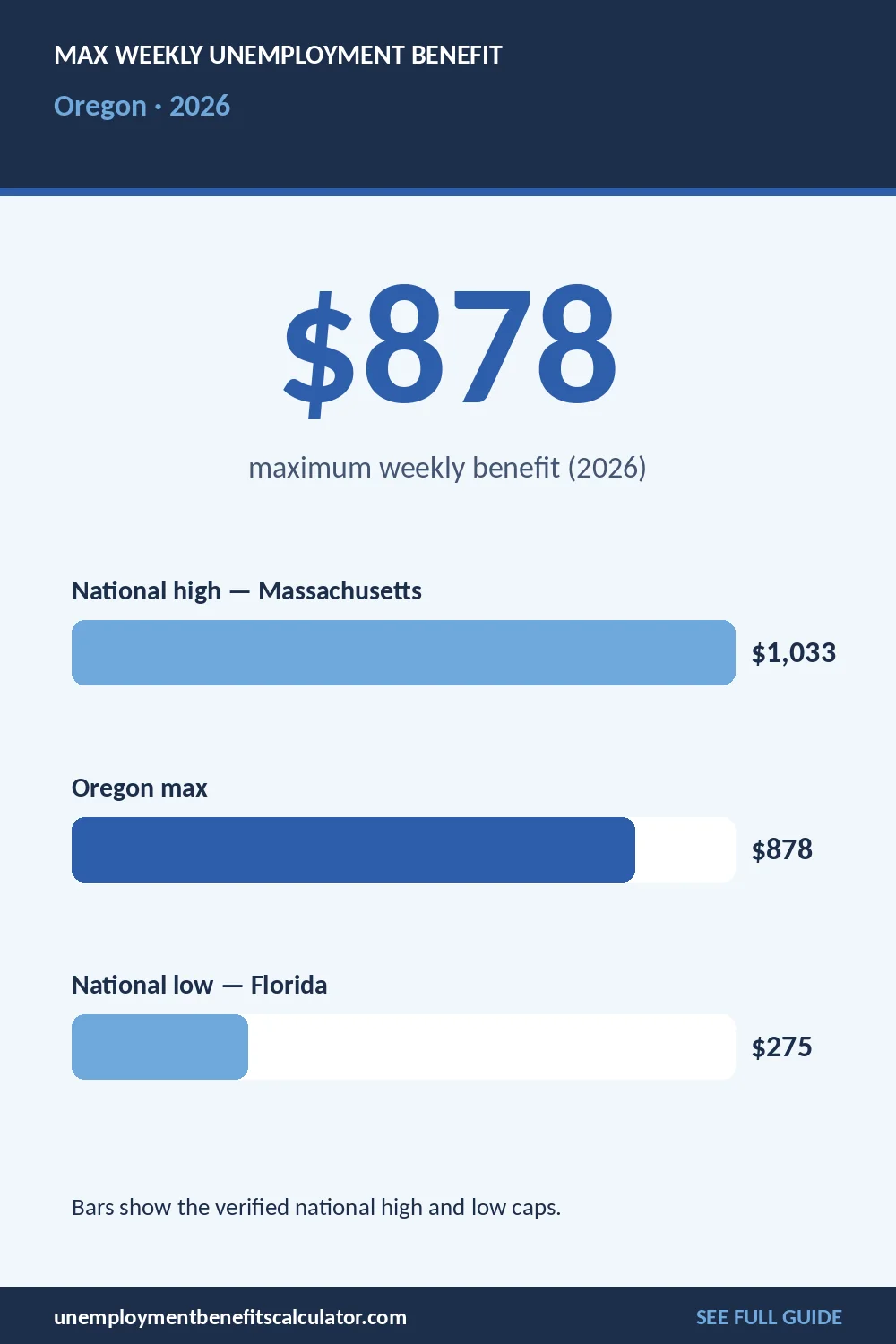
Oregon's figures moved recently enough that stale numbers circulate widely. Older guides quote an $878 maximum and a $151 minimum, but the agency's current glossary states $211 and $902, and the difference is not cosmetic: a thin claim that would have priced near $160 now clears the new floor at $211, and planning math built on $878 understates the ceiling by $24 a week. The fix is to price every claim against the current pair and the 1.25 percent rule together, and the calculation walkthrough runs the formula with the machinist's numbers.
The formula's shape changes strategy in ways quarter-based states never teach. Because 1.25 percent reads the whole base period, steady employment across four quarters prices better than a single explosive quarter, and a year with a long unpaid stretch can drop the weekly amount below what the wage total suggests. Our base-period guide shows which window Oregon reads for a claim filed today, and the high-quarter explainer contrasts the Oregon method with the neighboring states' quarter math.
Why Does Week One Pay Nothing?
Oregon law requires one waiting week per claim: the first week you file a weekly claim and meet all eligibility requirements pays nothing, though claiming it is mandatory. The machinist filed on the Monday after his layoff, certified week one accurately, and received zero dollars for it, exactly as designed. The problem is not the rule, it is the surprise, because claimants from Washington or California, which pay from week one, read the empty week as a rejected claim.
The remedy is sequencing. A claim filed the week the job ends serves its waiting week immediately and starts paying in week two, while a late filing burns the identical week later in the calendar. Since the 26 payable weeks sit inside a fixed 52-week benefit year, the waiting week effectively shortens the paid runway whenever filing lags. Our waiting-week guide compares the rule across states, and the first-payment timeline guide sets the realistic expectation: money in week two of the claim, assuming clean answers and no adjudication.
When Does the First Payment Arrive?
Oregon's first payment follows the waiting week, so the realistic answer is money in week two of the claim for a clean filing, with the machinist's deposit landing on the third business day after his second certification. Payments run by direct deposit or the ReliaCard prepaid debit, elected in the application, and the payment-method guide compares the two where it matters, at fees and refund cycles. The first-payment timeline guide sets expectations for every stage between.
Delays cluster around three causes, and each has a different clock: identity verification that never finished, a wage record that disagrees with the pay stubs, and an employer report that has not landed yet. The delayed-payment guide sorts them in the order they occur, and Oregon's online claim system shows which stage a claim is actually sitting in, which is the first place to look before assuming the worst.
Log Five Activities, Two With Employers
Oregon requires at least five work-search activities every certified week, and at least two of the five must be contacts with potential employers. The machinist built a routine that satisfied it without friction: two employer applications early in the week, one workshop or networking event mid-week, and two supporting activities, résumé revisions and follow-up calls, at the end. Registration with WorkSource Oregon attaches to the claim, and Frances Online is where the weekly answers and the search record live.
Weeks where the log cannot back the answers get reversed with overpayments attached, which is the enforcement mechanism, not a theoretical one. The answer is a dated log in the format the agency recognizes, and the log-format guide shows it. The failed-search guide explains reversal mechanics, and the networking guide sorts which events count among the five, because not everything that feels like searching does.
Read the Training Unemployment Insurance Option
Oregon runs a Training Unemployment Insurance program that replaces the five-activity hunt with approved classroom time, and it is the single most underused feature of the state's system. The machinist's shop neighbor enrolled in a CNC programming certificate, satisfied eligibility through attendance, and finished the retrain with three weeks of the claim still banked. Enrollment needs the department's sign-off before classes start, which is the detail applicants discover too late.
The school-while-claiming guide explains which programs qualify and how the approval sequence runs. Self-employment assistance shares the same family of programs, for claimants whose next step is a business rather than a boss, and the business-while-claiming guide covers the reporting duties that come with it.
How Does the 40-Hour Rule Kill Part-Time Weeks?
Oregon's definition is unusual: you are unemployed in a week only when you work fewer than 40 hours and earn less than your weekly benefit amount. Both conditions, hours and dollars, must hold. A wood-products worker who picks up 42 hours of temp labor in a week earns nothing for that week even at modest pay, and a claimant whose part-time check crosses the weekly amount loses the week to the dollar test instead.
The fix here is week design, not luck. Keep part-time weeks under the 40-hour line and under the weekly amount, report the gross for the week the work happened, and the claim stays alive with a reduced or full check. At the $902 ceiling the dollar test is generous, but at a $440 computed rate the cliff arrives at modest earnings. The part-time guide, the disregard breakdown, and the reporting guide between them cover the arithmetic, and the certification preview maps the screens where hours and dollars get reported.
What Freezes an Oregon Claim Mid-Flight?
Employer contests freeze Oregon claims until adjudication resolves the two accounts, and the machinist's restructure drew one: the employer's initial report coded the separation ambiguously, payments stalled for two weeks, and the written reduction notice ended the question. The cure is documentation speed, responding within days rather than weeks, and the contest guide describes the packet that ends freezes fastest.
Offsets run in the background. Pensions from base-period employers reduce the weekly amount, severance packages can postpone the claim's start, and lump-sum payouts allocate across specific weeks. The pension guide, the severance guide, and the lump-sum guide cover each interaction, and seasonal workers should read the seasonal guide before assuming off-season availability reads the way they hope.
Run the 20-Day Window Correctly
Oregon allows 20 calendar days measured from the postmark to appeal any determination, from the computed weekly amount to a full denial. The appeal lands before an administrative law judge, heard by phone, and document-backed cases dominate the wins. The machinist never needed the hearing, but his freeze response followed the same logic: paper first, narrative second. The appeal walkthrough and the hearing guide lay out both, and the disqualification guide previews which separations carry which burden of proof.
Certification continues through any appeal, because a won determination pays the certified backlog and skipped weeks stay gone regardless of outcome. That pairing, appeal fast and certify always, is the decision rule that separates claims that recover from claims that collapse.
Handle the Overpayment Notice Early
Overpayment notices in Oregon usually trace to the certification answers, and the 40-hour rule doubles the arithmetic surface where mistakes happen. The department recalculates after the wage match, mails the notice, and starts a clock that belongs to a different system than the weekly claim. The machinist's crew lead answered one in week eleven over a misdated temp shift, and the correction closed inside two weeks because the pay stub matched the story.
The notice lists repayment, appeal, and waiver paths with deadlines attached, and the overpayment response guide walks each with the documentation it needs. Ignored notices refer to collections and can attach to future claims, which is the outcome the first response prevents. The certification-mistakes catalog and the fraud-penalties guide between them draw the line between honest slips and knowing misstatements, a line worth reading before the next certification rather than after the notice.
Do School Employees File Under Different Rules?
School workers file under the reasonable-assurance frame, and Oregon applies it strictly between terms. A classroom aide claiming summer weeks with a fall contract waiting gets denied no matter how the certification reads, and the denials arrive quickly because the school calendar does the adjudicating. The school-employee guide maps the weeks that can pay and the weeks that cannot.
Substitute teachers, bus drivers, and coaches sit in the same family with slightly different fact patterns, and the seasonal certification guide covers the answer patterns that keep their between-season claims honest. The machinist's sister coaches winter track, and her claim succeeded precisely because the season's end date did the work the search requirement otherwise would.
How Does Oregon Tax the Benefits?
Benefits are taxable for the IRS and for Oregon's return, and the department withholds nothing automatically. The machinist's full run at $440 produced about $11,440 of taxable income, which he covered with the 10 percent federal election and a manual reserve for the state layer. Claimants who skip both elections owe the full bill in April, and Oregon's top rate makes the surprise larger than most states'. The unemployment tax guide works the withholding math, and the January 1099-G, downloadable from Frances Online, feeds both returns.
Payment arrives by direct deposit or the ReliaCard prepaid debit, and the choice is made in the application. The payment-method guide compares the two on fees and timing, which matters more at Oregon's biweekly rhythm than claimants expect.
Keep a Team Whole With Work Share
Oregon's Work Share program is the employer-side alternative the sawmill never invoked: reduce hours across the crew, let partial benefits fill the gap, and keep the workforce assembled for the recovery. The machinist had watched a Eugene fab run it through a slow order book, and the crew came out the other side intact, which is the program working as designed. Employers apply through the department, and the shared-work guide covers the setup and the employee-side arithmetic.
Relocation has its own rule set. An Oregon claim keeps Oregon rules after a move, provided the search continues and availability stays honest in the new location, and the relocation guide walks the notification sequence. The remote-worker guide covers the reverse case, where the claimant never moves but the employer's state claims the filing.
Disasters, Strikes, and Mixed Wage Records
Oregon's disaster unemployment assistance activates after federally declared events, and wildfire seasons have made it a real program rather than a theoretical one for parts of the state. The claims run on different wage rules that count self-employment and farm work the regular formula ignores, which is precisely why the monetary test treats them differently. The thin-history guide explains who otherwise falls through the monetary test, and the application window after a declared event is shorter than most people expect. Striking workers face their own frame, and the strike-eligibility guide covers the narrow lanes where benefits run during a labor dispute.
Mixed wage records deserve a note of their own in Oregon, because the 1.25 percent formula reads the whole base period rather than a best quarter. A year split between a W-2 job and 1099 contracting prices lower than the W-2 half alone would suggest, and the self-employment guide explains which wages entered the calculation and which stayed out. Claimants whose records look wrong on the determination should dispute inside the 20-day window with the pay stubs attached, which is the same advice every other section of this guide keeps arriving at.
$23,452 and the 52-Week Frame
Twenty-six times the $902 ceiling totals $23,452, the program's hard annual maximum, and the 52-week benefit year is the frame that holds it: when the benefits exhaust, no new Oregon claim opens until the year ends, even if weeks remain unclaimed. The machinist's claim closed at week 24 with a standing job offer, two weeks unspent, and the exhaustion guide plus the stretching guide explain how partial work and careful certification manage that runway.
Against the region, Oregon prices below Washington's program and above Idaho's, and the whole ranking sits in the maximums table with the comparison guide turning it into dollar differences for identical histories. The trade Oregon makes is visible in this guide's own sections: a distinctive formula, a strict search count, and a waiting week, exchanged for a $211 floor that no thin claim in the neighborhood matches.
The decision summary, compressed: file the week work ends through Frances Online, claim the waiting week knowingly, hold the five-activity log with two employer contacts, keep part-time weeks under 40 hours and under the weekly amount, respond to any contest with paper inside days, and calendar the 20-day appeal window against every determination. Run the sequence while the layoff is fresh, and when any figure here seems to have moved, cross-check it against the federal UI directory before planning around it.
Frequently Asked Questions
How much is unemployment in Oregon in 2026?
Oregon multiplies your total base-period wages by 1.25 percent and clamps the result between $211 and $902 per week. Steady four-quarter histories price better than single-quarter spikes under this formula. A full 26-week run at the ceiling totals $23,452, and the maximum sits inside a fixed 52-week benefit year.
Does Oregon have a waiting week?
Yes. One waiting week applies to every claim: the first week you file and meet all eligibility requirements pays nothing, but claiming it is mandatory. File the week work ends and the served week passes immediately, with payable weeks starting in week two; a late filing burns the identical week later in the calendar.
What are Oregon's work search requirements?
At least five work-search activities every certified week, and at least two of the five must be contacts with potential employers. Registration with WorkSource Oregon attaches to the claim, and the weekly answers live in Frances Online. Weeks the dated log cannot support get reversed with overpayments attached.
Can I work part-time and still get Oregon unemployment?
Yes, under a two-condition rule: you are unemployed in a week only when you work fewer than 40 hours and earn less than your weekly benefit amount. Both must hold. At the $902 ceiling the dollar test is generous, but at lower computed rates the cliff arrives fast, so design part-time weeks under both lines.
Does Oregon tax unemployment benefits?
Yes. Benefits are taxable income for the IRS and for Oregon's return, and the department withholds nothing automatically. The optional 10 percent federal election covers only the federal layer, so reserve for Oregon's tax separately, and download the January 1099-G from Frances Online for both returns.
How many days to appeal an Oregon unemployment denial?
20 calendar days counted from the determination's postmark. The appeal lands before an administrative law judge, heard by phone, and paper-decided cases outnumber argument-decided wins. Keep certifying throughout the process, because a won determination pays the certified backlog while weeks you skipped stay gone regardless.