
Table of Contents
- Pennsylvania Unemployment Compensation at a Glance
- How Much You Can Get in Pennsylvania in 2026
- Who Qualifies in Pennsylvania
- Filing Your Pennsylvania Claim, Step by Step
- Weekly Certification in Pennsylvania
- How Long Pennsylvania Benefits Last
- Part-Time Work and Partial Benefits in Pennsylvania
- If Pennsylvania Denies Your Claim: Appeals in 21 Days
- Identity Verification and the Pennsylvania Paper Trail
- Construction, Health Care, and Seasonal Work in Pennsylvania
- Work Sharing and Training Options in Pennsylvania
- A Short Pennsylvania Checklist Before You File
- Payments and the Pennsylvania 1099-G
- Taxes on Pennsylvania Unemployment Benefits
Pennsylvania Unemployment Compensation at a Glance
Pennsylvania calls its program Unemployment Compensation. The state runs it through its own dedicated portal rather than a general labor department catch-all. The program pays up to $573 per week for a standard 26 weeks, adds dependent allowances on top.
Enforces a two-activity weekly work search. Pennsylvania's filing experience is more structured than most: the state's identity verification. Employer-response process both run on fixed clocks that reward early, complete submissions.

The Commonwealth's formula keys off your highest quarter of wages. Makes Pennsylvania a favorable state for workers with one strong quarter rather than a steady average. At the same time, its earnings disregard for partial weeks is modest.
Workers planning part-time hours need the state math before choosing schedules. This guide covers the full picture for 2026: amounts, eligibility, filing, certifications, appeals, and taxes.
Nationally, Pennsylvania sits in the upper half for weekly amounts and in the middle for process friction. The state comparison guide frames the national picture. The Pennsylvania unemployment calculator estimates your weekly amount from your wage history before you file.
How Much You Can Get in Pennsylvania in 2026
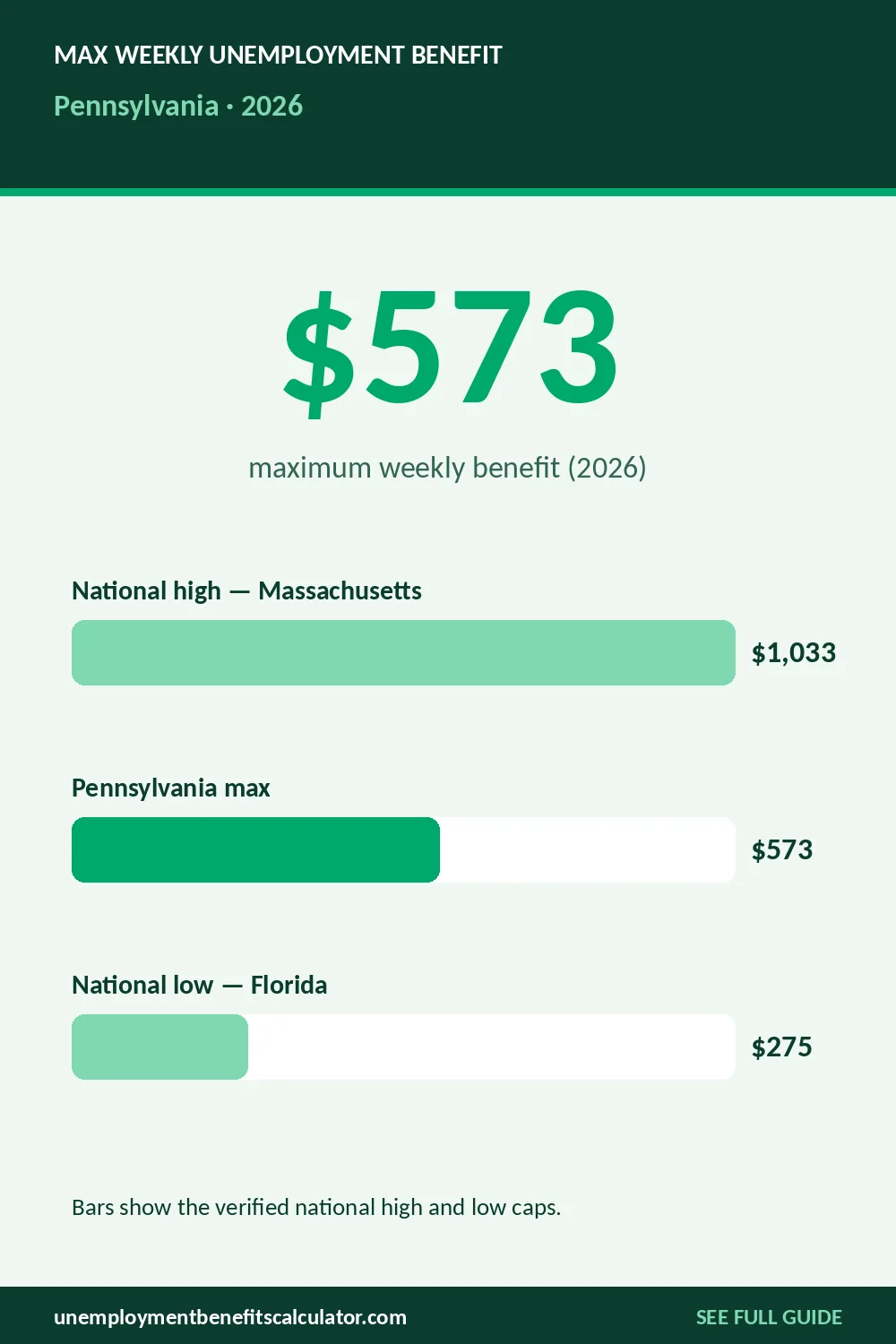
Pennsylvania computes your weekly benefit from your highest quarter of base period wages using a formula that works out to roughly one-twelfth of that quarter. A maximum of $573 and a minimum of about $35 per week for claimants without dependents.
Reaching the $573 ceiling takes roughly $6,900 in your best quarter, a bar that full-time workers at. Above the state's median wage typically clear.
| Item | Pennsylvania 2026 value |
|---|---|
| Maximum weekly benefit | $573 |
| Minimum weekly benefit | About $35 (higher with dependents) |
| Dependent allowance | Additional dollars per week for a spouse and qualifying children |
| Standard duration | 26 weeks |
| Work search requirement | 2 work search activities per week |
| State tax on benefits | Yes (Pennsylvania's flat income tax applies) |
The dependent allowance is Pennsylvania's quiet advantage for families. Claimants with a non-working spouse or qualifying children see their weekly amount and their minimum rise together.
Changes the calculus for workers whose base wages alone would price near the bottom of the scale. The dependents allowance guide explains how the additions are structured and documented.
Extended Benefits can extend Pennsylvania's duration when federal triggers activate in severe downturns, though the program rests in normal years. The Extended Benefits guide covers the trigger mechanics, and the base period guide explains the wage window the formula reads.
Who Qualifies in Pennsylvania
The monetary test requires base period earnings of at least your highest quarter times a statutory multiple. Wages spread across a second quarter of the lookback window. The practical reading: Pennsylvania wants at least two quarters of activity.
A best quarter strong enough to support a weekly rate above the minimum. Workers who miss the standard test should explore whether wages from adjacent quarters or another state complete the record. The monetary eligibility guide explains the anatomy of the test.
Separation rules follow the national architecture. Layoffs and hour reductions qualify cleanly, quits need substantial fault on the employer side or compelling personal circumstances. Discharges put the burden on the employer to prove willful misconduct connected with the work.
Pennsylvania's willful misconduct standard excludes good-faith errors in judgment. The fired-for-cause guide shows how the line plays out in real cases.
Weekly eligibility requires ability, availability, and the two-activity work search. Pennsylvania also requires registration with its career-matching system within 30 days of filing.
A step that silently blocks payments when missed. The availability guide covers the able-and-available standard, and the work search guide explains what counts as an activity.
Filing Your Pennsylvania Claim, Step by Step
File the week your employment ends, because Pennsylvania pays nothing for weeks before your application. The state's online portal is the primary channel, with a statewide phone line as the alternative. Before starting, gather:
- Social Security number and a photo ID
- Your two most recent pay stubs and your W-2 if the job has ended
- Employment history for the last 18 months with employer names, addresses, phone numbers, and dates
- Your SEPA/direct-deposit banking details for payment
- Separation paperwork, if you received any, such as a layoff notice or final disciplinary letter
The application asks your separation story, your wage history, and your availability, then issues a PIN and a confirmation letter. Your employer receives notice and can respond within its own window, and conflicting accounts trigger fact-finding.
Pennsylvania's identity verification step catches a meaningful share of filers at this stage. Have your documents handy and complete it promptly, because payments hold until it clears.
Read the monetary determination against your own pay stub math. If the computed benefit looks wrong, request a wage review with documentation immediately. The recompute rules freeze your weekly amount for the benefit year once established.
Wage investigations fix misfiled quarters, missing bonuses. Wages reported under the wrong state, and the WBA calculation guide shows what the record should contain.
Weekly Certification in Pennsylvania
Pennsylvania certifies weekly, asking whether you worked, gross earnings, availability, and your two work search activities. The two-activity standard is lighter than neighboring New Jersey's expectations but still audited on a sampling basis.
Keep a dated log with employer names and contact methods. The log format guide shows records that survive review.
The earnings question uses gross figures for the week earned, including tips and commissions. Pennsylvania's partial benefit credit works out to roughly 30% of your weekly benefit. Meaning the state ignores about that much in earnings before reducing the check.
Earnings that exceed your benefit plus the credit zero the week out. A $573 claimant can earn roughly $170 in a week before reductions begin. The disregard guide runs the scenarios and the part-time rules guide covers the schedule side.
Missed certifications create gap weeks that need backdating with a documented reason. Pennsylvania's portal handles the request with its own short window.
The missed deadline guide walks the repair. The certification questions guide previews the full weekly screen so nothing surprises you.
How Long Pennsylvania Benefits Last
Pennsylvania pays up to 26 weeks inside a 52-week benefit year. The dependent-adjusted weekly amount holding steady across the runway.
Zero-payment weeks from earnings generally count against the total. Partial workers planning schedules should factor the burn rate alongside the check size.
When benefits exhaust before employment resumes, Pennsylvania's retraining and reemployment services run through its career system. Federal Extended Benefits can activate in severe downturns.
The exhaustion guide sequences realistic next steps. The interstate claims guide helps workers with wage history across state lines decide where a claim prices best.
Part-Time Work and Partial Benefits in Pennsylvania
Pennsylvania's partial benefit credit of roughly 30% of the weekly benefit makes modest part-time weeks nearly cost-free but larger weeks expensive fast. A claimant with a $573 benefit. $200 In weekly gross earnings keeps the full payment because the credit absorbs the earnings. The same claimant earning $500 loses roughly $330 of the check.
That cliff shape rewards hour planning. Splitting 20 hours across two light weeks beats concentrating them in one heavy week whenever the employer allows flexibility. The credit resets every certification week.
Report gross figures for the week earned, include tip income. Remember that PTO payouts and bonus allocations land in their assigned weeks. The lump-sum guide covers the allocation rules, and the certification reporting guide shows the weekly mechanics.
Pennsylvania also runs a Short-Time Compensation program for employers who reduce hours across a unit instead of laying workers off. Friendlier benefit math than the regular partial formula.
Workers facing formal slowdowns should point HR at the program. The work sharing guide explains the enrollment mechanics from both sides.
If Pennsylvania Denies Your Claim: Appeals in 21 Days
Pennsylvania's determination letter states the decision and the reason. The appeal window is 21 calendar days from the communication date, one of the shorter windows in the country.
First-level appeals go to a Referee hearing with the Office of Unemployment Compensation Benefits Review. Held by phone, with a written decision afterward.
The short window makes same-week action the only safe plan. File the appeal the day the determination lands, then assemble evidence for the hearing. Willful misconduct is the employer's burden in discharge cases.
Pennsylvania referees expect documents more than adjectives, so bring schedules, write-ups, and correspondence. The appeal guide, the hearing preparation guide, and the employer contest guide cover the full sequence.
Pennsylvania-specific traps worth naming: skipping the 30-day career-system registration, missing the identity verification step. Letting fact-finding deadlines lapse during the first weeks of the claim.
Each has a short repair path measured in days. The application mistakes guide collects them before filing rather than after.
Identity Verification and the Pennsylvania Paper Trail
Pennsylvania's identity verification step stops more claims than any adjudication dispute. The state validates claimant identities against its records before releasing the first payment. Filers whose information does not match automatically, often because of name changes, hyphenation.
Transposed digits, receive a request for documents rather than a determination. The requests run on clocks measured in days, and unclaimed payments hold indefinitely until the verification clears.
The document package that clears verification is short. A government photo ID, a Social Security card or W-2 showing the number. Any name-change paperwork if the wage record uses a prior name.
Upload through the portal rather than mailing originals. Confirm the portal shows the documents as received, because the queue has swallowed clean uploads before. Claimants stuck in verification should read the first payment timeline guide to distinguish verification holds from ordinary processing.
The same precision applies to the employer list on the application. Pennsylvania reads employer names and dates against its wage record, and mismatches produce fact-finding questions that delay the monetary determination. Pull the exact legal names from old pay stubs rather than storefront signs.
Include every employer from the last 18 months, including part-time and short-lived jobs you might consider irrelevant. The pre-filing information guide covers the full document list.
Construction, Health Care, and Seasonal Work in Pennsylvania
Pennsylvania's claim mix runs through three industries with distinctive claim patterns. Construction workers face project-end layoffs that arrive cleanly but seasonally. The between-project availability question decides their certifications: available for dispatch counts.
The state accepts union hall activity as work search. The union member guide covers the dispatch rules, and the seasonal certification guide covers the winter pattern.
Health care workers, Pennsylvania's largest employment sector, see claim questions centered on scheduling and refusals. Health systems that cut per-diem hours produce partial eligibility questions. Refused shifts produce refused-work fact-finding that hinges on the shift's reasonableness.
The suitable work guide explains when declining a shift protects the claim. The reduced schedule guide covers the hour-cut scenarios.
Seasonal employers across the Poconos and the Alleghenies create the between-seasons pattern where Pennsylvania's partial credit matters most. A resort worker claiming between seasons can pick up scattered weeks at partial rates without burning the full 26-week runway.
Provided the weekly math stays inside the credit window. The seasonal workers guide and the disregard guide run the arithmetic together.
Work Sharing and Training Options in Pennsylvania
Pennsylvania operates a Short-Time Compensation plan that lets employers reduce hours across a unit instead of laying off. The state replacing a defined portion of the lost wages under rules friendlier than the regular partial formula. Employees on an approved plan avoid the dollar cliff that ordinary part-time weeks hit.
Makes the program worth raising with HR before formal slowdowns. The work sharing guide explains enrollment from the employer side.
Training programs change the availability rules for claimants approved into them. Pennsylvania's workforce system can approve retraining plans that relax the requirement to search for prior-occupation work. Effectively funding a career transition with the benefit weeks.
Approval comes before enrollment, and the sequence matters: career center first, plan approved, then certifications adjusted. The school-while-claiming guide walks the approval logic.
Both options share Pennsylvania's structural lesson: the 21-day appeal clock. The 30-day registration deadline are the two dates that most reward fast action. The claimants who calendar them at filing time avoid the standard self-inflicted denials.
The benefit period guide shows the full sequencing from filing to final week. The maximization guide pairs it with the planning calendar.
A Short Pennsylvania Checklist Before You File
Five checks prevent most Pennsylvania problems. Pull the exact legal employer names from pay stubs, scan your identity documents for name mismatches against the wage record. Plan the two weekly activities into your routine from the first day, decide on federal withholding before the first payment lands.
Calendar the 21-day appeal window the moment any determination arrives rather than the day you finish reading the letter. The pre-filing checklist guide covers the document list. Pennsylvania rewards claimants who finish it before the application rather than after.
Payments and the Pennsylvania 1099-G
Pennsylvania pays weekly benefits by direct deposit or its state debit card. Deposits following a clean certification by two to three business days. The direct deposit option avoids card fee edges, and the payment method guide compares the two in detail.
Because the state's verification step precedes first payment. Claimants should confirm their banking details survived the identity process before assuming a processing delay.
The 1099-G arrives each January with total benefits and any elected federal withholding. Pennsylvania adds the state's flat tax on top at return time since no weekly state withholding exists.
The tax guide covers both layers. The overpayment guide covers the repayment adjustments that apply if a later redetermination reverses weeks. Which interacts with the same 1099-G.
That closes the Pennsylvania picture: file early, verify identity fast, log the two weekly activities without exception. Calendar the 21-day appeal window before you ever need it. Claimants who hold that discipline rarely need the appeal, and the ones who do arrive prepared rather than rattled.
Taxes on Pennsylvania Unemployment Benefits
Pennsylvania taxes unemployment benefits under its flat state income tax, in addition to the federal layer that applies everywhere. The state does not withhold tax from weekly payments, so the liability lands on your April return. The flat rate makes the estimate simple: multiply your total benefits by the flat percentage for the state piece.
Federal treatment follows the standard rules: fully taxable income, a 1099-G each January, and optional 10% withholding during the claim. The unemployment tax guide covers both return layers and the estimated-payment option for claimants who skipped withholding. The payment method guide explains how the weekly money arrives.
The overpayment guide covers the tax offsets that apply if a later redetermination recovers benefits. Is the last piece of the Pennsylvania tax picture most claimants see.
Frequently Asked Questions
How much is unemployment in Pennsylvania in 2026?
Pennsylvania pays up to $573 per week, with a minimum around $35 that rises with dependent allowances. The formula works out to roughly one-twelfth of your highest quarter of base period wages, so reaching the ceiling takes about $6,900 in a single quarter.
How many weeks does Pennsylvania unemployment pay?
Pennsylvania pays up to 26 weeks within a 52-week benefit year. Zero-payment weeks caused by earnings generally count against the total, and Extended Benefits can add weeks only when federal triggers activate in a severe downturn.
Does Pennsylvania tax unemployment benefits?
Yes. Pennsylvania's flat state income tax applies to unemployment benefits in addition to federal tax. The state does not withhold from weekly payments, so plan for the state liability on your April return; the flat rate makes the estimate simple arithmetic.
What are the work search requirements in Pennsylvania?
Pennsylvania requires two documented work search activities per week, plus registration with its career-matching system within 30 days of filing. Missing the registration silently blocks payments, and the state samples weekly activity records, so keep a dated log.
Can I work part time and still get unemployment in Pennsylvania?
Yes. Pennsylvania's partial benefit credit ignores roughly 30 percent of your weekly benefit in earnings before reducing the check. A $573 claimant can earn about $170 in a week with no reduction, while a $500 week cuts the payment by roughly $330.
What is the deadline to appeal a Pennsylvania unemployment denial?
Twenty-one calendar days from the date the determination was communicated, one of the shortest windows nationally. File the appeal the day the determination arrives, then gather schedules, write-ups, and correspondence for the referee hearing.