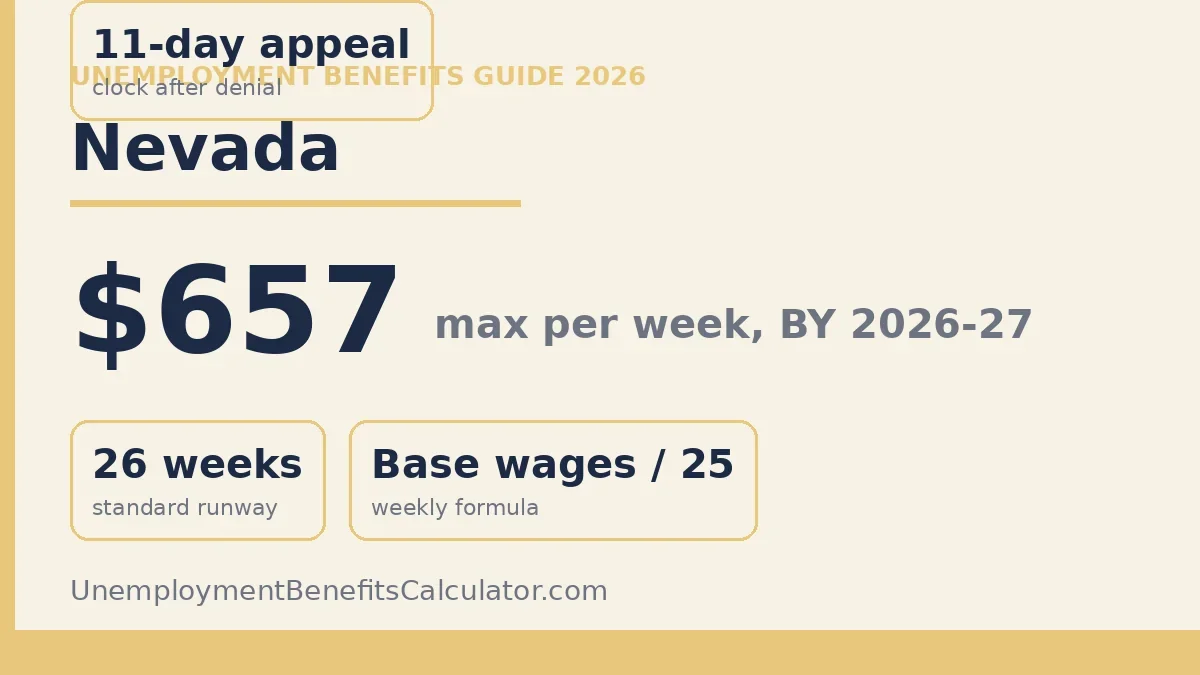
Quick Answer: Nevada pays $16 to $657 per week for benefit years running July 1, 2026 through June 30, 2027. The state divides your base-period wages by 25, and reaching the $657 cap takes $16,425 in base wages. Claims run up to 26 weeks after one unpaid waiting week.
Nevada prices unemployment differently from every neighboring state. Instead of reading your best quarter the way Utah and Oklahoma do, the state divides total base-period wages by 25.
The 2026-27 formula pays up to $657 per week, up $26 from the prior benefit year, on a standard runway of 26 weeks.
Checks land between $16 and $657. Three weekly work-search activities plus an 11-day appeal clock ride along. Readers weighing Nevada against its neighbors can start with the state comparison table.
| Item | Nevada value (benefit year 2026-27) |
|---|---|
| Weekly formula | Total base-period wages divided by 25 |
| Minimum weekly benefit | $16 |
| Maximum weekly benefit | $657 (up $26 from the prior benefit year) |
| Standard runway | Up to 26 weeks |
| Waiting week | One unpaid week |
| Work search | Three documented activities per week |
| Appeal window | 11 days from the determination's mailing date |
| Dependent additions | None |
The $657 Answer for 2026-27 Claims
The ceiling for 2026-27 claims is $657 per week. Reaching it takes $16,425 in total base-period wages, because 25 multiplied by $657 marks the exact input. The minimum check is $16, a floor that only binds the thinnest qualifying records.
Estimate Your Exact Weekly Benefit
State formulas use base-period wages, not your last paycheck. Your rate depends on your high quarter and the state cap.
Open the Free Nevada Calculator →A Las Vegas hospitality worker with $26,000 in base wages prices at $1,040 under the raw division. The cap engages, so that claimant collects $657 instead. A Reno warehouse worker with $9,500 in base wages prices at $380 with no cap in sight.
The divide-by-25 design pays steady multi-year workers better than peak-quarter states do. A strong second and third quarter lift the check instead of sitting outside the formula.
Six-figure earners collect the same $657 as a $16,425 wage record, a gap that the state maximums page puts in context.
The state adds no dependent additions to the weekly figure. A single parent and a single earner with identical wages receive identical checks, a difference explored in the dependents guide.
How Do Your Base Wages Become a Weekly Check?
Your weekly check starts from the base period. That window takes the four earliest of your five most recently finished quarters, and every dollar of covered wages inside it divides by 25.
The base period guide lays out the window's calendar mapping for a claim filed this quarter. The earnings requirements walkthrough covers the wage-counting rules.
A claim needs wages spread across at least two quarters to stand. Repeat claimants need income at least three times the weekly benefit they drew on the prior claim.
Nevada Department of Employment, Training and Rehabilitation states both tests on its benefits page. The employer handbook plus the federal July 2026 comparison table back these figures, rechecked October 28, 2026.
Quarterly bonuses inside the window raise the weekly check permanently, as the lump sum guide and the overtime and bonus explainer explain.
But a strong quarter alone cannot rescue a weak window, unlike the high-quarter states. That trade-off is quantified in the formula comparison.
Register on EmployNV Before You File
Register on EmployNV before you file, even before the separation paperwork settles. The intake wants a driver license or state ID plus your Social Security number.
You also need employer names and addresses from the last 18 months, your last day worked, and the separation reason. Have banking details ready for direct deposit if you prefer it to the debit card.
Filing the same week you are laid off matters doubly here. The waiting period runs from filing rather than separation, and benefits do not backdate.
Claimants who want a sequence can follow the online application walkthrough in the filing guide. The document checklist in the pre-filing checklist covers the rest of the paperwork.
Workers leaving with a separation package should scan the package rules and the severance interplay in the severance guide before answering intake questions. The answers bind the adjudication review later.
Serve the Waiting Week, Then Certify Weekly
Nevada opens every claim with one unpaid waiting week. You certify for that first week like any other, it pays nothing, and payment begins with the second certified week.
The waiting week guide compares designs across states, and the certification questions guide previews the weekly questions.
The weekly cycle runs on reporting honesty from the first certification onward. Gross wages earned during a week go on that week's certification even if the paycheck has not arrived.
Part-time work is allowed, with earnings deducted from the weekly figure. Vacation, holiday, and severance payments deduct under the rules in the severance reduction guide and the income reporting guide.
A missed certification is a lost week, and the appeal clock below runs only 11 days. The missed deadline explainer and the mistakes guide help you avoid both problems.
Three Work-Search Activities: What Counts?
Nevada expects three documented work-search activities every week, logged and available for audit. Completed applications, interviews, and approved networking or hiring events count, while passive scrolling does not.
The search log guide templates the documentation formats that hold up. The requirements overview summarizes the legal basis, and the job fair rules settle the networking question.
Two claimant groups carry modified duties. Union members with hiring halls satisfy the weekly duty through the hall's dispatch process, described in the union member guide.
Workers on temporary layoff who hold a definite recall date can be excused from searching for the recall window. The furlough guide covers the same pattern.
Everyone else treats three activities as a floor. Failures bring a denial of the weeks in question plus potential overpayment, documented in the failed search guide.
What Breaks a Nevada Claim?
Three failures end Nevada claims in practice, and the first is the separation fight.
Misconduct connected to the work, from attendance terminations to policy violations, disqualifies the weeks that follow. Ordinary performance shortfalls generally do not, and the boundary gets tested hearing by hearing.
The fired guide walks the termination patterns, and the performance guide covers the shortfall side. Quits without good cause disqualify until the claimant returns to work and earns the prescribed amount.
The quit guide explains that standard, alongside the good cause variants in the good cause explainer.
The second failure is the availability and work-search audit, and the failed requirements guide catalogs the failure modes. Mid-claim reviews compare the weekly certifications against the logged activities.
The third failure mode is fraud. Knowingly false statements on a claim or certification bring penalty disqualifications and repayment demands with interest, machinery set out in the overpayment playbook.
Answer every certification question as if an auditor will read it. In Nevada, an auditor eventually will.
Seasonal claimants and students carry the highest audit rates here. The availability definitions deserve a slow read before the first certification goes in.
The 11-Day Appeal Clock
Nevada's appeal window is the shortest in the country. You have 11 days from the determination's mailing date to file an appeal with the Appeals Tribunal.
The determination letter carries the filing instructions. Hearings run as formal proceedings with a recorded record, and both the claimant and the employer can appeal.
The appeal-building sequence, from evidence gathering to the hearing itself, runs through the denial appeal guide. The hearing preparation steps are in the hearing walkthrough.
A disputed determination needs a decision within days, not weeks. Continuing weekly certifications during the appeal keeps the back-pay window open if you win.
The Tribunal's decision opens its own short window for the next level, so calendar every date the notice prints the day it arrives.
Employers contest separations on the same 11-day schedule. The employer contest guide covers their burden on misconduct and attendance separations, the fired guide the fired-side scenarios, and the absenteeism guide the attendance patterns.
How Do Payments and Withholding Work?
Payments leave the department only after the waiting week is served and the certification clears, arriving by direct deposit or on a prepaid debit card.
The payment methods guide weighs the card versus deposit trade-offs, from fee schedules to posting speed. A payment that stalls has its own triage path in the payment delay guide.
Replacing a debit card mid-claim adds a week of waiting, so hold the card details with the claim file.
Withholding follows the same election model at the federal level. The department takes federal income tax from each check only when the claimant requests it, at 10 percent.
Nothing is withheld for state income tax because Nevada levies none. The annual total lands on the 1099-G regardless of the election, and the filing-season mechanics run through the unemployment tax guide.
Child support obligations intercept through a separate channel before the check is issued. The deduction appears on the same annual statement, which catches noncustodial parents by surprise every January.
What Happens at the End of the Benefit Year?
A Nevada benefit year runs 52 weeks from the claim's effective date. Claims that exhaust or lapse inside that year can restart under the reopening rules carried in the reopening guide.
A new benefit year requires fresh monetary eligibility. For repeat claimants the test is income at least three times the prior year's weekly benefit amount.
Workers whose year ends while still unemployed should re-file rather than assume continuation. The fresh-claim test reads the new base period. A quarter of re-employment wages can requalify a year even when the prior claim exhausted.
The benefits-run-out guide maps the exhaustion options.
Extended benefits and federal programs can attach during high-unemployment periods, as the extended benefits map and the extension programs guide explain. Neither is active in Nevada now.
Claimants planning school or training inside the benefit year should read the school rules first. Approved training changes both the search duty and the availability standard.
Taxes: No State Income Tax, Federal by Election
Nevada levies no state income tax, so the benefit-year tax picture is federal only. Benefits are taxable federally, and the 1099-G reports the annual total. The department withholds federal income tax only when you elect it, at 10 percent.
The election decision, the quarterly planning, and the April consequences are laid out in the unemployment tax guide. Other income streams follow the same federal rules.
Payment delivery runs through direct deposit or a prepaid debit card. The fee-and-timing comparison in the payment methods guide covers the trade-offs.
Claimants juggling a partial return to work should recheck the withholding election after the first month of actual checks. The income mix changes the optimal rate.
Overpayment balances, including ones from misreported weeks, demand repayment, and the overpayment playbook lays out the collection machinery. The fraud framework behind the steepest penalties is summarized in the disqualification overview.
Decide With the Numbers, Then File
Run the division first. Total base-period wages divided by 25, clamped between $16 and $657, is your check. The weekly estimator automates it if your records are scattered.
Decide the withholding election at filing rather than at tax season, using the tax guide above. Calendar the 11-day appeal window the day any determination arrives.
Build the three-activity log weekly with the formats from the search log guide. Then file early in the week you separate, because the waiting week and the effective-date rule make delay the only mistake that never reverses.
Claimants with wages in more than one state should read the interstate rules before choosing the filing state. Anyone weighing a move mid-claim should clear it against the moving guide first.
Pull the quarterly wage statements before filing rather than reconstructing them from memory. Nevada's formula rewards the claimant who adds up every quarter and answers every certification on time.
Check Your Nevada Estimate in 2 Minutes
Enter your quarterly wages to see your estimated weekly benefit, your maximum duration, and where the cap applies.
Calculate Your Benefits Now →Frequently Asked Questions
How much is unemployment in Nevada in 2026?
Nevada divides your total base-period wages by 25 and pays between $16 and $657 per week for benefit years starting July 1, 2026. The $657 cap takes $16,425 in base wages, while a $9,500 record prices at $380.
Why does Nevada divide benefits by 25 instead of using the best quarter?
The state prices the week from the entire base period instead of the single strongest quarter, so every quarter you worked adds to the check. The design favors steady workers, while peak-quarter states reward one hot stretch.
Is there a waiting week for Nevada unemployment?
Yes. Every claim opens with one unpaid waiting week, which you certify for like any other week. Payments begin with the following week, and the waiting period runs from filing rather than the separation date.
How many work searches does Nevada require each week?
Three documented work-search activities per week, entered with the weekly certification and subject to audit. Completed applications, interviews, and approved hiring events count, while passive browsing does not. Claimants with a definite recall date can be excused.
What is Nevada's deadline to appeal a determination?
Eleven days from the determination's mailing date, the shortest appeal window in the country. File with the Appeals Tribunal, expect a formal recorded hearing, and keep certifying weekly so a win pays the back weeks.
Does Nevada tax unemployment benefits?
Nevada has no state income tax, so only the federal side applies. Benefits are taxable federally, the 1099-G reports the annual total, and the department withholds federal tax only if you elect the 10 percent option.
How does Nevada send unemployment payments?
Payments start once the waiting week is served and certification clears. They arrive by direct deposit or on a prepaid debit card, per your intake election. Replacing a card mid-claim can add a week of waiting.
Can you work part-time and still certify in Nevada?
Yes. Part-time work is allowed, and gross wages earned during a week go on that week's certification even if the paycheck has not arrived. Earnings are deducted from the weekly figure, and vacation, holiday, and severance payments deduct too.