
Table of Contents
- New Jersey Unemployment Insurance at a Glance
- How Much You Can Get in New Jersey in 2026
- Who Qualifies in New Jersey
- Filing Your New Jersey Claim, Step by Step
- Weekly Certification in New Jersey
- How Long New Jersey Benefits Last
- Part-Time Work and Partial Benefits in New Jersey
- If New Jersey Denies Your Claim: Appeals in 10 Days
- Industry Notes: Pharma, Logistics, and the Two-State Commuter Belt
- New Jersey Fact-Finding: The High-Stakes Exchange
- Work Sharing, Training, and the New Jersey Fallback Ladder
- A Short New Jersey Checklist Before You File
- New Jersey's Dependents Additions: How the Family Math Works
- Taxes on New Jersey Unemployment Benefits
New Jersey Unemployment Insurance at a Glance
New Jersey operates one of the most generous unemployment systems in the country. Paying up to roughly $1,000 per week for a standard 26 weeks. Dependent additions on top and no waiting week consuming the start of the runway.
Claims run through the state Department of Labor's online portal. The two-thirds wage replacement formula means mid-career professionals routinely collect checks that approximate their take-home pay.

Generosity brings scrutiny: New Jersey's verification steps, employer contests. Certification cross-matches all run at high volumes, and the appeal window is among the shortest in the nation.
This guide covers the full 2026 picture for New Jersey workers, from the formula through taxes. The state-specific mechanics that decide whether the paper generosity becomes actual money.
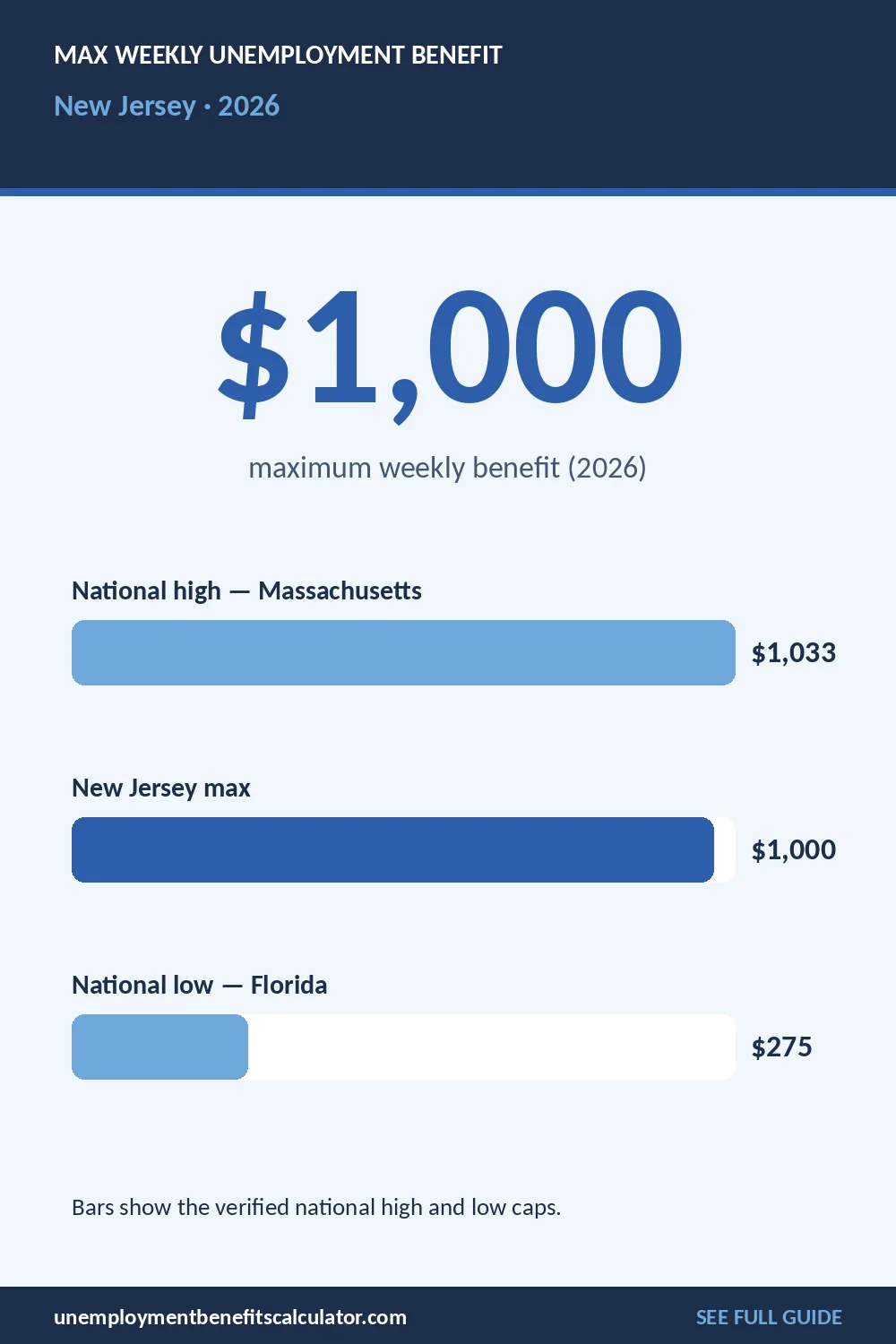
Nationally, New Jersey pairs with Massachusetts and Washington at the top of the weekly-amount table. The state comparison guide frames the tier. The New Jersey unemployment calculator estimates your weekly amount from your wage history.
How Much You Can Get in New Jersey in 2026
New Jersey computes your weekly benefit as two-thirds of your average weekly wage. The average comes from your highest quarter of base period wages divided by 13.
The result carries a minimum in the low $200s and a maximum just over $1,000 per week. Dependent additions of a few percent per qualifying child stack on top for claimants with families.
| Item | New Jersey 2026 value |
|---|---|
| Maximum weekly benefit | Just over $1,000 |
| Minimum weekly benefit | In the low $200s |
| Dependent addition | Percentage increase per qualifying child |
| Standard duration | 26 weeks |
| Waiting week | None (payable from the first week) |
| Work search requirement | 3 work search activities per week |
The two-thirds formula is the reason New Jersey claimants sometimes collect more than colleagues in neighboring Pennsylvania earn per week gross. The state replaces a larger slice of the wage, not just a larger slice of a smaller base. Reaching the ceiling takes a high quarter above roughly $20,000, a bar that full-time professional.
Union-scale workers in the state's metro economy clear routinely. The WBA calculation guide compares this formula family against the high-quarter and two-quarter models other states use.
Extended Benefits can extend the 26-week runway when federal triggers activate in severe downturns. New Jersey's dense labor market means trigger conversations arrive more often than in most states. The Extended Benefits guide covers the mechanics, and the base period guide explains the wage window feeding the formula.
Who Qualifies in New Jersey
The monetary test requires base period earnings across at least two quarters with enough total wages to produce a benefit above the minimum. New Jersey's high minimum means very thin histories fail the test entirely.
Workers who miss it should check whether an alternate wage window or interstate wages complete the record. The monetary eligibility guide covers the anatomy, and the recompute guide explains the freeze that makes early wage investigations urgent.
Separation rules follow the national architecture with New Jersey's worker-friendly precedents. Layoffs qualify cleanly, quits need good cause attributable to the work or compelling personal circumstances. New Jersey's precedent list recognizes a broader set of personal-necessity quits than its neighbors.
Discharges require the employer to prove misconduct connected with the work, and the state's definition excludes simple unsatisfactory performance. The good cause guide and the fired-for-cause guide map both tests.
Weekly eligibility requires ability, availability, and three documented work search activities per week. New Jersey accepts applications, interviews, and career-center services toward the count, and it samples records on a rolling basis. The availability guide covers the able-and-available standard, and the log format guide shows records that survive audits.
Filing Your New Jersey Claim, Step by Step
File the week your employment ends, because New Jersey pays nothing for weeks before your application. The state portal handles filing and all correspondence.
The system's identity-verification step stops a meaningful share of first payments until documents clear. Before starting, gather:
- Social Security number and a government photo ID
- Employment history for the last 18 months with employer names, addresses, phone numbers, and dates
- Your last pay stub with gross wages and year-to-date totals
- Dependent documentation if claiming the child additions
- Banking details for direct deposit, which most New Jersey claimants use
The application captures your separation story and wage history, then schedules weekly certifications. Employers receive notice and respond at high rates in New Jersey's dense employment market.
Conflicting accounts produce fact-finding with short windows. Department of Labor's UI program page keeps the official directory current, and the state posts its own processing times.
Read the monetary determination against your own two-thirds math immediately. Wage-record errors suppress New Jersey benefits materially because the formula scales directly with the high quarter.
An early wage investigation with stubs fixes what a year of underpayment cannot. The tipped wage guide and the recompute guide cover the two most common correction patterns.
Weekly Certification in New Jersey
New Jersey certifies weekly, asking whether you worked, gross earnings, availability, and your three work search activities. The certification drives a check that is large by national standards. Makes it disproportionately attractive to get wrong by accident.
The state's cross-match against employer payroll records runs on the same quarterly cycle as everywhere else. The dollar-for-dollar stakes scale with the benefit.
Report gross figures for the week earned, including tips, commissions, and bonus allocations that land in the certification week. New Jersey's partial formula includes a 20% earnings disregard, one of the cleaner allowances in the country. Earnings that exceed roughly your benefit plus the disregard zero the week out.
The disregard guide runs the scenarios. The lump-sum guide covers the bonus and settlement allocations that wreck certifications when guessed at.
Missed certifications need backdating with a documented reason. New Jersey's repair windows run short relative to its generous windows elsewhere. The missed deadline guide walks the process, and the certification questions guide previews the full screen.
How Long New Jersey Benefits Last
New Jersey pays up to 26 weeks inside a benefit year with no waiting week at the front. Means the runway starts paying immediately. Zero-payment weeks from earnings count against the maximum in most scenarios.
Partial workers should treat the 26-week budget alongside the weekly math. The benefit period guide shows the sequencing.
When benefits exhaust, New Jersey's dense job market and training infrastructure offer genuine fallback options. Federal Extended Benefits can activate in downturns. The exhaustion guide sequences the steps.
Workers with wage history across the river can read the interstate claims guide. New York wages can support a second claim for workers whose careers span both states.
Part-Time Work and Partial Benefits in New Jersey
New Jersey's 20% disregard makes it one of the best states for combining part-time wages with benefits. The formula: your payment equals your weekly benefit minus 80% of gross earnings.
A $1,000 claimant earning $400 in a part-time week still receives $680. Earnings past roughly the benefit-plus-disregard line zero the week, which at New Jersey's ceilings takes substantial hours.
The math makes the state's claimant behavior distinctive: reduced-hours workers file at higher rates because partial checks are genuinely meaningful. The same documentation discipline applies nonetheless. A 20% disregard on a $1,000 benefit means every reporting error is worth $800 rather than $300.
The part-time rules guide covers the schedule questions. The overtime guide covers the allocation weeks that interact with the formula.
If New Jersey Denies Your Claim: Appeals in 10 Days
New Jersey's determination states the decision and the reason. The appeal window is 10 calendar days from the mailing date, among the shortest in the nation. First-level appeals go to an Appeal Tribunal hearing by phone, with a written decision afterward.
The short window makes same-day filing the only safe plan. New Jersey's portal accepts the appeal with a one-click flow once the determination is open.
The state's worker-friendly precedents mean many denials reverse at the tribunal level when the record arrives complete. Separation letters, schedules, texts, and wage records outweigh narrative arguments.
The appeal guide and the hearing preparation guide cover the format. The employer contest guide explains the exchange from notice to decision.
New Jersey-specific traps worth naming: missing the 10-day window by waiting for employer conversations to finish. Skipping the identity-verification step until the first payment stalls.
Understating gross earnings on high-value checks. The application mistakes guide collects the checklist, and at New Jersey's benefit levels the cross-match stakes justify reading it twice.
Industry Notes: Pharma, Logistics, and the Two-State Commuter Belt
New Jersey's claim mix runs through three engines. Pharmaceutical and medical-sector layoffs cluster around research cycles and site consolidations. The wage records behind them usually support the state ceiling cleanly.
The live questions are severance timing, which the severance guide covers. Relocation offers after site closures, which the relocation guide answers.
Logistics and warehouse workers along the Turnpike corridor. Around Port Newark see staffing-agency employment patterns that split wage records across entities. At New Jersey's two-thirds formula a merged record moves the weekly amount by real hundreds.
The recompute guide explains the freeze that makes early wage investigations urgent. The monetary eligibility guide explains how merged records count.
The two-state commuter belt raises the interstate question constantly. New Jersey residents laid off from New York jobs, and vice versa. The claim generally files in the state where the work happened, not where you live.
New York's $504 ceiling prices below New Jersey's for identical salaries. The interstate claims guide covers the filing rules. The choice matters more here than in any other metro pair in the country.
New Jersey Fact-Finding: The High-Stakes Exchange
New Jersey's fact-finding carries unusual stakes because the weekly amounts are unusual. When your employer responds with a different separation story, the department mails a questionnaire whose written record decides the determination.
The cross-match mathematics mean every week of delay on a $1,000 claim costs $1,000. The exchange rewards two-day responses with exact dates and attached documents, the same discipline as everywhere else but priced higher.
Employer contests in New Jersey run at high rates. The state's worker-friendly precedents mean many denials reverse at the tribunal when the record arrives complete.
The employer contest guide shows the full exchange, the hearing preparation guide covers the tribunal. The first payment guide separates normal verification holds from contested files.
Work Sharing, Training, and the New Jersey Fallback Ladder
New Jersey operates a work sharing program for employers who cut hours across a unit instead of laying off. The state replacing a defined slice of lost wages under rules friendlier than the regular partial formula. At New Jersey's benefit levels the program's math is genuinely valuable.
Workers seeing formal slowdowns should raise it with management early. The work sharing guide explains the mechanics.
Retraining through the state's workforce system can adjust availability requirements for approved claimants, converting benefit weeks into funded transition time. Approval precedes enrollment, and the sequence matters: career center, plan, then certification changes.
The school-while-claiming guide covers the logic. The benefit period guide shows the sequencing across a 26-week runway that starts paying immediately because there is no waiting week.
A Short New Jersey Checklist Before You File
Five checks fit New Jersey's system. Run the two-thirds self-audit against your best quarter, scan your identity documents before the verification step stalls the first payment.
Plan the three weekly activities from day one, decide on federal withholding knowing both tax layers price against the state's large checks. Calendar the 10-day appeal window the moment any determination lands.
The application mistakes guide expands the list. At New Jersey's benefit levels every checklist item carries double weight. The same mistakes cost more here than anywhere else in the region.
The state's generosity is real, and so is its paperwork. Claimants who match the documentation to the dollar amounts collect the checks the formula promises. The ones who round corners fund the state's fraud recovery unit one overpayment at a time.
New Jersey's Dependents Additions: How the Family Math Works
New Jersey's dependent additions are percentage-based rather than flat-dollar. Makes them the most valuable family add-ons in the country at the top of the wage scale. Claimants with a qualifying spouse or civil-union partner.
Dependent children see the weekly benefit rise by defined percentages per dependent, subject to a cap. At the state's maximum the additions add real hundreds per week rather than token amounts.
Qualification runs on specifics that the verification step checks. The dependent must meet the state's relationship and support tests. The claimant's documentation needs to match: tax-return dependency, school enrollment for older children, and the spouse's income situation all matter.
Claimants whose circumstances changed mid-year, through a new child. A spouse returning to work, should update the claim rather than certifying from stale assumptions. The cross-match reads household data the same way it reads payroll.
The additions also interact with the partial-benefit formula in a way worth planning around. A higher weekly amount raises the earnings ceiling where weeks zero out. Means a dependent-inclusive claim tolerates more part-time income before the check disappears.
The dependents allowance guide compares the state structures. The disregard guide shows how the higher ceiling changes the part-time arithmetic.
Families filing in New Jersey should claim the additions from day one. The recompute freeze makes mid-claim corrections slower than getting it right at filing.
Taxes on New Jersey Unemployment Benefits
New Jersey taxes unemployment benefits as state income in addition to the federal layer. At the state's weekly amounts the combined liability is real money.
The state does not withhold from weekly payments, so the state piece lands on your April return. The optional 10% federal withholding during the claim covers only the federal layer.
The arithmetic is worth doing mid-claim. A 26-week run at the maximum produces over $26,000 of taxable income, and both layers price against it. The unemployment tax guide covers the return lines.
The estimated-payment option for claimants who skipped withholding, the payment method guide explains how the weekly money arrives. The overpayment guide covers the repayment adjustments that interact with the same 1099-G when weeks are later reversed.
Frequently Asked Questions
How much is unemployment in New Jersey in 2026?
New Jersey pays up to just over $1,000 per week, computed as two-thirds of your average weekly wage from your highest quarter, with dependent additions on top. The minimum sits in the low $200s, and the state is among the three highest-paying in the country.
How many weeks does New Jersey unemployment pay?
New Jersey pays up to 26 weeks within a benefit year, with no waiting week at the front. Zero-payment weeks caused by earnings count against the maximum in most scenarios, and Extended Benefits can extend the runway in severe downturns.
Does New Jersey have a waiting week for unemployment?
No. New Jersey pays from the first week of your claim, which effectively adds one check compared with states that still deduct an unpaid waiting week before benefits begin.
What are the work search requirements in New Jersey?
New Jersey requires three documented work search activities per week, including applications, interviews, and career center services. The state samples records on a rolling basis, so keep a dated log matching your weekly certifications.
What is the deadline to appeal a New Jersey unemployment denial?
Ten calendar days from the mailing date, among the shortest windows in the nation. File the appeal through the portal the day the determination arrives, then assemble separation letters, schedules, and wage records for the tribunal hearing.
Does New Jersey tax unemployment benefits?
Yes. New Jersey applies state income tax to benefits in addition to federal tax, and the state does not withhold from weekly payments. At New Jersey's benefit levels the combined liability is substantial, so the mid-claim withholding decision deserves a deliberate answer.