
Table of Contents
- Virginia Unemployment Insurance at a Glance
- How Much You Can Get in Virginia in 2026
- Who Qualifies in Virginia
- Filing Your Virginia Claim, Step by Step
- Weekly Certification in Virginia
- How Long Virginia Benefits Last
- Part-Time Work and Partial Benefits in Virginia
- If Virginia Denies Your Claim: Appeals in 30 Days
- Industry Notes: Defense, Tech, and the Virginia Service Economy
- Virginia Fact-Finding: The Two-Number Determination
- Work Sharing, Training, and the Virginia Fallback Ladder
- Payments, the 1099-G, and a Short Virginia Checklist
- Two Virginia Claimants, Same Check, Different Runways
- Taxes on Virginia Unemployment Benefits
Virginia Unemployment Insurance at a Glance
Virginia's Virginia Employment Commission runs a program that pairs mid-range weekly amounts with an unusually individualized duration. Benefits last between 12. 26 Weeks depending on your own wage history, not just the state's economy.
Claims file through the VEC's online portal, a one-week waiting period starts the runway. The work search asks for two documented activities per week.

The wage-based duration makes Virginia's claim math a two-variable exercise: your weekly amount. Your week count both price off your base period. Two claimants with identical weekly checks can have runways four weeks apart.
This guide covers the full 2026 picture for Virginia workers, from the formula through taxes. The state-specific details that decide the difference.
Nationally, Virginia sits mid-table on amounts and above-average on process orderliness. The state comparison guide frames the context. The Virginia unemployment calculator estimates your weekly amount from your wage history before you file.
How Much You Can Get in Virginia in 2026
Virginia computes your weekly benefit as 52% of your average weekly wage. The average comes from your two highest quarters of base period wages divided by 26. Subject to a minimum of $60.
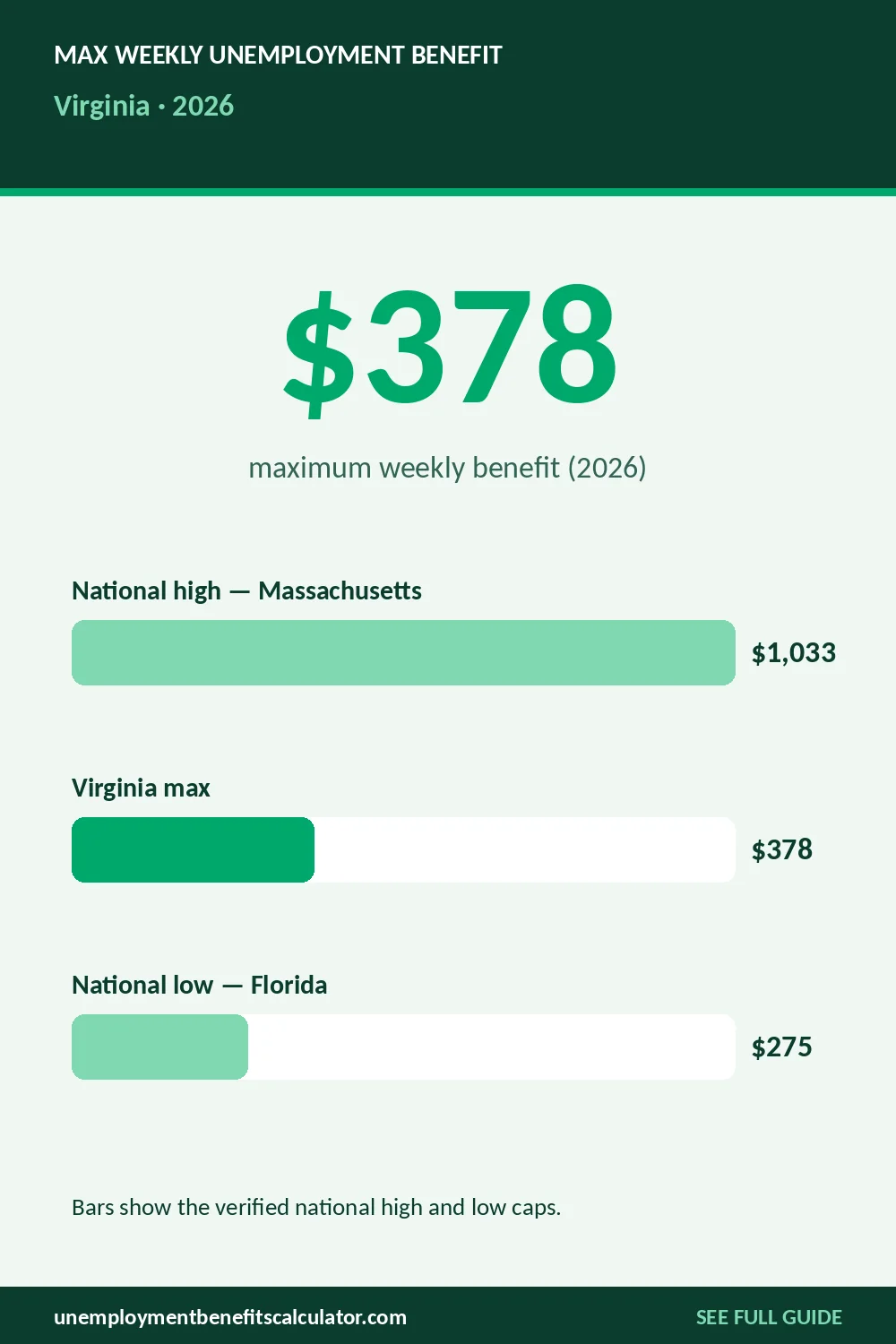
A maximum of $378 per week. The two-quarter smoothing rewards steady employment, and the 52% replacement rate sits at the national norm.
| Item | Virginia 2026 value |
|---|---|
| Maximum weekly benefit | $378 |
| Minimum weekly benefit | $60 |
| Standard duration | 12 to 26 weeks, based on your own wage history |
| Waiting week | One week (unpaid) before benefits begin |
| Work search requirement | 2 work search activities per week |
| State tax on benefits | Yes (Virginia income tax applies) |
The wage-based duration deserves its own explanation. Virginia computes your potential weeks from the relationship between your base period wages. Your weekly amount: workers whose wages spread across quarters earn longer runways.
Workers whose wages concentrate in a single quarter see shorter ones. Your determination letter states both the weekly amount and your total week count, which is the number to plan around. The benefit duration guide explains how duration formulas differ across states.
Extended Benefits can extend the runway when federal triggers activate in severe downturns, though the program rests in normal years. The Extended Benefits guide covers the trigger mechanics, and the base period guide explains the wage window feeding both formulas.
Who Qualifies in Virginia
The monetary test requires base period wages across at least two quarters with enough total earnings to support a weekly rate above the $60 minimum. Virginia also prices the duration from the same record, so the qualification question and the runway question answer together.
Workers with thin histories should check whether adjacent quarters or interstate wages complete the record. The monetary eligibility guide covers the mechanics.
Separation rules follow the national architecture with Virginia's specific precedents. Layoffs and hour reductions qualify cleanly, quits need good cause attributable to the employment or compelling personal circumstances.
Discharges require the employer to prove misconduct connected with the work under Virginia's definitions, which exclude good-faith performance errors. The good cause guide and the fired-for-cause guide map both tests with case patterns.
Weekly eligibility requires ability, availability, and two documented work search activities per week. Registered through the VEC's job-matching system as part of the claim.
The state samples records, and the same logging discipline applies: employer names, methods, dates, and outcomes matching your certifications. The availability guide covers the standard, and the log format guide shows records that survive audit.
Filing Your Virginia Claim, Step by Step
File the week your employment ends, because Virginia pays nothing for weeks before your application. With a wage-based runway each lost week matters double.
The VEC portal handles filing, and the state's workforce centers assist claimants who prefer in-person help. Before starting, gather:
- Social Security number and a government photo ID
- Employment history for the last 18 months with employer names, mailing addresses, phone numbers, and dates
- Your last pay stub with gross wages
- Banking details for direct deposit
- Any separation paperwork, such as a layoff notice or final write-up
The application captures your separation story and wage history, then issues both your weekly amount and your week count. Employers receive notice and can respond, and conflicting accounts produce fact-finding questionnaires with short deadlines.
Virginia posts processing information, and the U.S. Department of Labor's UI resources keep the official directory current.
Read the determination against your own 52% math, and note both numbers it states. Wage-record errors suppress Virginia benefits and durations simultaneously.
An early wage investigation with pay stub evidence fixes both before the recompute freeze locks the claim for the benefit year. The first payment timeline guide sets expectations for the weeks after filing.
Weekly Certification in Virginia
Virginia certifies weekly through the portal. Its automated line, asking whether you worked, gross earnings, availability, and your two work search activities.
The answers drive the weekly payment. The state's cross-match against employer payroll runs on the standard quarterly cycle, so precision prevents most downstream disputes.
Report gross figures for the week earned, including tips and commissions. Virginia's partial formula reduces payments dollar for dollar above a small weekly allowance.
Earnings that meet or exceed your weekly benefit zero the week while it still counts against your wage-based balance in most scenarios. The disregard guide runs the scenarios, and the certification reporting guide covers the weekly mechanics.
Missed certifications need backdating with documented reasons, and the missed deadline guide walks the repair. The certification questions guide previews the full screen. Virginia's version asks about school attendance and self-employment activity in addition to the standard battery.
How Long Virginia Benefits Last
Your runway runs from the waiting week through the week count your determination states. 26 Weeks, bounded by your benefit year.
Because the duration prices off your own record, the planning conversation differs from flat-duration states. A claimant with 18 weeks should compress the job search timeline accordingly rather than anchoring to the national 26-week assumption.
When benefits exhaust, Virginia's workforce programs and retraining services run through the VEC system. Federal Extended Benefits can activate in severe downturns. The exhaustion guide sequences the options.
Workers with wage history in neighboring states can check the interstate claims guide. Maryland and North Carolina wages can support separate claims for border-region workers.
Part-Time Work and Partial Benefits in Virginia
Virginia allows part-time work with a small weekly earnings allowance before dollar-for-dollar reductions begin. Earnings at or above the weekly benefit zero the week.
At the $378 maximum, part-time weeks grossing $380 or more erase the check. Catches service workers in Northern Virginia's wage levels more often than the state's average suggests.
The hour-planning math pairs with the wage-based duration: zero-payment weeks count against your stated week count. A part-time schedule that repeatedly zeroes checks burns the runway without buying coverage.
The part-time rules guide and the disregard guide cover the formulas. Workers facing formal slowdowns can raise the work sharing option the work sharing guide describes.
If Virginia Denies Your Claim: Appeals in 30 Days
Virginia's determination states the decision and the reason, and the appeal window is 30 calendar days from the mailing date. First-level appeals go to an Administrative Law Judge through the VEC's appeals process.
Held by phone, with a written decision afterward. The record decides most cases, so assemble separation documents, schedules, and correspondence before the hearing rather than arguments alone.
Employer contests in Virginia most often allege misconduct or recast separations as voluntary. Virginia's misconduct standard requires a willful or deliberate violation connected with the work.
Good-faith performance failures usually fall short, and claimants whose write-ups cite speed or production should argue that distinction directly. The appeal guide, the hearing preparation guide, and the employer contest guide cover the full sequence.
Virginia-specific traps worth naming: missing the registration step in the job system, reporting net rather than gross earnings. Assuming a 26-week runway that your wage history never supported. The application mistakes guide collects the checklist before filing.
Industry Notes: Defense, Tech, and the Virginia Service Economy
Virginia's claim mix runs through three engines with distinct claim patterns. Defense and government-contractor layoffs follow contract cycles and funding cliffs. The wage records behind them usually support the ceiling cleanly.
The live question is the security-adjacent job search, where clearance requirements and availability answers interact. The availability guide covers the standard. Contractor workers should document the contract end date precisely because it anchors the separation narrative.
Northern Virginia's tech economy produces corporate layoffs with severance packages that interact with the claim's first weeks. The allocation rules decide whether the package delays benefits.
The severance guide covers the mechanics. The lump-sum guide covers the retention bonuses and PTO payouts that ride along with tech separations.
Hampton Roads and the port economy run shift-based logistics employment with staffing-agency splits that suppress wage records until investigations merge them. The two-quarter formula prices the merged record into both the weekly amount and the wage-based duration. The recompute guide explains the freeze, and the temp agency guide covers the assignment-end pattern.
Virginia Fact-Finding: The Two-Number Determination
Virginia's fact-finding exchange follows the national pattern with one state-specific wrinkle. The monetary determination states both your weekly amount and your wage-based week count. Wage-record disputes move both numbers simultaneously.
A missing quarter can drop the check and shorten the runway at the same time. Makes the investigation request more urgent than in flat-duration states.
The written questionnaire decides the determination. Two-day responses with exact dates and attached documents outperform better facts with slower paperwork.
The employer contest guide shows the exchange, the monetary eligibility guide explains how merged records count. The first payment guide separates normal processing from a stuck file.
Work Sharing, Training, and the Virginia Fallback Ladder
Virginia operates a state work sharing program for employers who cut hours across a unit instead of laying off. The state replacing a defined slice of lost wages under rules friendlier than the regular partial formula.
Workers seeing formal slowdowns should raise it with management before the cuts land, because enrollment runs at the employer level. The work sharing guide explains the mechanics.
Retraining through the VEC's workforce system can adjust availability requirements for approved claimants, converting benefit weeks into funded transition time. The wage-based duration makes the sequencing math interesting: an approved program converts whatever weeks your record supports into training coverage. The school-while-claiming guide covers the approval logic, and the benefit period guide shows the sequencing.
Payments, the 1099-G, and a Short Virginia Checklist
Virginia pays by direct deposit or its state debit card. Deposits typically landing two to three business days after a processed certification.
The payment method guide compares the two, and the January 1099-G reports the totals that both tax layers price against. The tax guide covers the layers, and the overpayment guide covers the repayment adjustments that interact with the same form.
Five checks fit Virginia's system: verify the wage record against pay stubs before trusting either stated number. Confirm your determination's week count.
Plan around it rather than a national assumption, register the two weekly activities from day one. Decide on federal withholding knowing it covers only the federal layer.
Calendar the 30-day appeal window the day any determination arrives. The application mistakes guide expands the list. In Virginia the checklist is really two checklists: one for the check, one for the runway.
Verify both numbers on your determination the day it arrives, because the wage record drives them together. The claimant who fixes the record in week one collects both the amount. The duration the law intended while the claimant who waits meets the freeze instead.
Two Virginia Claimants, Same Check, Different Runways
Virginia's wage-based duration is easiest to understand through a pair. Marcus and Elena both compute a $378 weekly benefit, the state ceiling. Marcus's wages spread evenly across four quarters of steady salaried work, roughly $9,900 per quarter.
Elena's wages concentrate in two explosive quarters from a project-heavy contract year, with thin quarters bookending them. Both clear the ceiling; both checks match; their runways differ by weeks.
Virginia's duration formula reads the relationship between total base period wages and the weekly amount. Marcus's even spread produces the full 26-week maximum while Elena's concentrated history supports fewer weeks. Perhaps 20 or 21 depending on the arithmetic.
Neither did anything wrong; the state's design simply rewards wage persistence across the year. The benefit duration guide compares this model against flat-duration states. The WBA guide shows why the weekly amount alone hides the difference.
The practical lesson cuts both ways. Workers with lumpy histories should plan the job search against the stated week count rather than a 26-week assumption. The determination letter states the truth.
Workers approaching a layoff with any timing flexibility should understand that a single additional strong quarter can extend the runway materially under Virginia's formula. And both should verify the stated numbers against their own stubs. The recompute freeze locks both the check and the runway for the benefit year once the claim establishes.
Taxes on Virginia Unemployment Benefits
Virginia taxes unemployment benefits as state income in addition to the federal layer. The state does not withhold from weekly payments.
Both pieces land on your April return unless the optional 10% federal withholding was elected during the claim. The 1099-G reports the totals each January.
The combined estimate is worth a mid-claim calculation: the taxable total depends on your weekly amount. Your wage-based week count, both stated on your determination. The unemployment tax guide covers both layers.
The estimated-payment option, the payment method guide explains how the weekly money arrives. The overpayment guide covers the repayment adjustments that interact with the same 1099-G when weeks are later reversed.
Frequently Asked Questions
How much is unemployment in Virginia in 2026?
Virginia pays between $60 and $378 per week, computed as 52 percent of your average weekly wage from your two highest quarters of base period wages. The two-quarter smoothing rewards steady employment over single-quarter spikes.
How many weeks does Virginia unemployment pay?
Virginia pays between 12 and 26 weeks based on your own wage history, not just the state economy. Your determination letter states your exact week count, which is the number to plan your job search timeline around.
What are the work search requirements in Virginia?
Virginia requires two documented work search activities per week, registered through the VEC's job-matching system. The state samples records, so keep dated entries with employer names, contact methods, and outcomes matching your certifications.
Does Virginia tax unemployment benefits?
Yes. Virginia applies state income tax to benefits in addition to federal tax, and the state does not withhold from weekly payments. The optional 10 percent federal withholding covers only the federal layer, so estimate both pieces during the claim.
Can I work part time and still get unemployment in Virginia?
Yes, with a small weekly earnings allowance before dollar-for-dollar reductions begin. Earnings at or above your weekly benefit amount zero the week, and zero-payment weeks count against your wage-based week count.
What is the deadline to appeal a Virginia unemployment denial?
Thirty calendar days from the mailing date of the determination. Appeals go to a phone hearing with an Administrative Law Judge, and the documentary record decides most cases, so file early and gather separation documents and schedules.