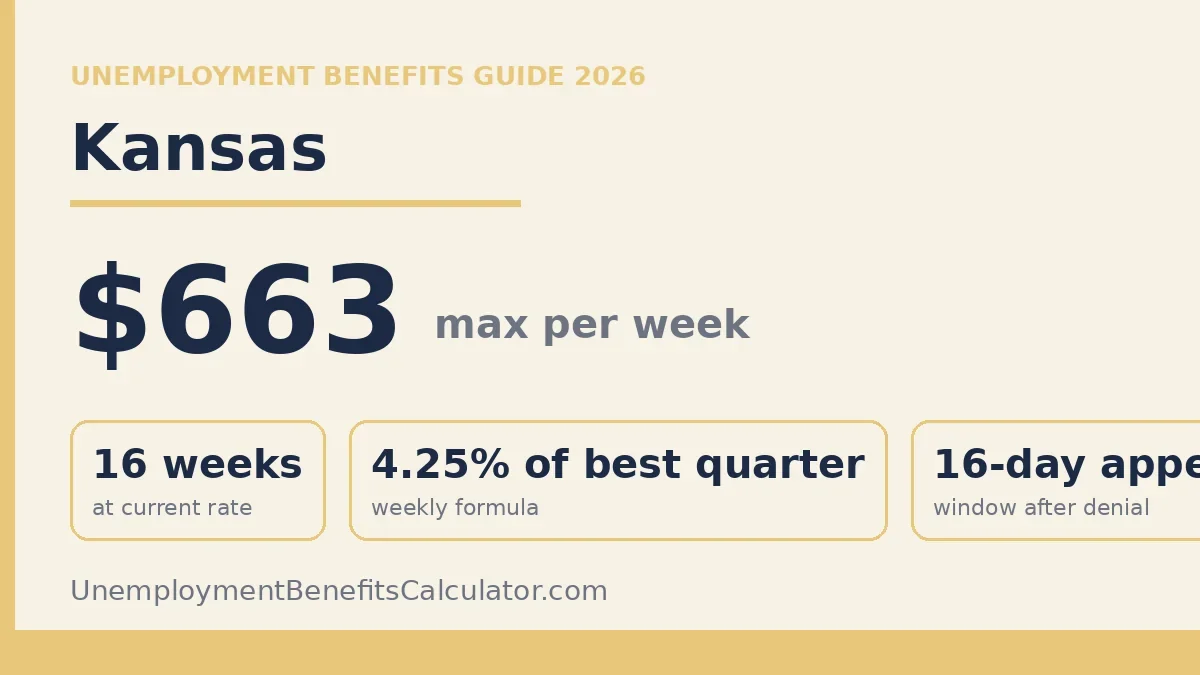
Quick Answer: Kansas pays 4.25 percent of your highest base-period quarter, from a $165 floor to a $663 ceiling. Claims pay 16 weeks after a single unpaid waiting week, with a 16-day appeal window. Certify weekly, keep your search log dated, and price the claim before filing.
Kansas prices the weekly check at 4.25 percent of your highest base-period quarter, a formula so literal that the $663 ceiling engages at exactly $15,600 in that one quarter.
And the $165 floor holds the bottom of a schedule that pays for 16 weeks at the current unemployment rate, between a one-week waiting period and a 16-day appeal clock.
The answer-first summary for anyone mid-claim this week.
Divide your best quarter by the 4.25 percent rule, land between $165 and $663 per week, serve one unpaid waiting week, log three work-search activities weekly.
And file any appeal inside 16 days of the mail date.
The cross-state frame sits in the state comparison table, and the runway question is priced in the duration comparison for workers whose wage records straddle the state line.
| Item | Kansas 2026 value |
|---|---|
| Weekly formula | 4.25 percent of the highest quarter |
| Minimum weekly benefit | $165 |
| Maximum weekly benefit | $663 |
| Standard duration | 16 weeks at the current unemployment rate (10-16 by statute) |
| Waiting week | One week, unpaid |
| Work search | Three documented activities each week |
| Appeal window | 16 days from the mailing date |
$663 a Week on the 4.25 Percent Rule
The direct answer. Kansas multiplies your best quarter by 4.25 percent and pays the result, clamped between $165 and $663.
A Wichita machinist whose best quarter held $15,600 prices at the full $663, because 4.25 percent of that quarter is the cap itself.
A Topeka warehouse worker with a $9,400 quarter prices at $399, and a Lawrence food-service worker with a $4,700 quarter prices at $199.
The formula reads one quarter only.
So the other three quarters of the wage record never lift or drag the check, a design contrast drawn in the high-quarter versus averaging guide.
Three consequences follow from the answer. The 4.25 percent rate pays just under half out of the best quarter's weekly run rate, since a quarter spans thirteen weeks.
Dependent rules differ across states, and the dependents allowance comparison maps which states add weekly amounts for children.
The estimator in the weekly estimator automates the division for scattered wage records.
Kansas does not list dependent additions on its benefit schedule the way those states do, and the dependents guide shows what child-based additions look like where they exist.
Run the 4.25 Percent Math Before Filing
In 2026, The computation takes one input and one multiply. But the input window surprises claimants. The base period spans the four earliest out of the trailing five finished quarters.
So the most recent completed quarter waits outside. And a promotion-heavy final quarter may not price this claim at all.
The calendar mapping by filing quarter is laid out inside the base period guide, and your wage-counting rules, including which employers feed the record, run through the earnings requirements walkthrough.
Workers with thin or one-sided records should scan the no-work-history guide before assuming disqualification. And seasonal workers whose best quarter sits outside the current window can time the filing date using the strategies in the seasonal workers guide.
Kansas requires covered wages across the window and enough earnings for the 4.25 percent computation to clear the $165 floor.
And claimants whose best quarter straddles two jobs should confirm every employer reported the wages. Because an unreported quarter prices the whole claim down.
A determination that reads low against the pay records is fixable. But only through the correction and appeal channels.
And the fastest path runs through the wage documentation described in the earnings walkthrough.
Serve the Waiting Week, Then Certify Weekly
Kansas requires one unpaid waiting week per benefit year before payments begin, a rule anchored in the department's waiting-week FAQ under K.S.A 44-705(d).
Certify for which first week like any other. Because the certification habit formed there is your one the audited weeks inherit.
And a skipped week slides the runway back, a misstep the waiting week guide documents and the missed deadline explainer.
After your waiting week, the claim settles into any weekly rhythm.
Certify each week once it ends, report every dollar earned in that week regardless of when the paycheck lands. And answer the availability questions honestly.
The certification mechanics, from your questions asked to the deadline discipline, are covered in the certification guide, with the phone alternative in your phone certification rules.
Vacation, holiday, and severance payments deduct under your rules in the severance guide, and bonus payments allocate to the week they are paid per the bonus explainer.
The certification questions themselves track the national pattern with Kansas-specific edges.
Expect the work-and-earnings screen first, then the availability screen, then the work-search attestation that ties the weekly log to the claim.
Claimants traveling during a certification week should clear the rules in the travel certification guide first, and the phone path exists for weeks when the portal is unreachable, though the online filing keeps a timestamp record the phone line does not.
Price Your Kansas Week
Multiply your best quarter by 4.25 percent and compare it to the $663 ceiling. The Kansas calculator runs the clamp and the 16-week duration in one pass.
Open the Kansas Calculator →Log Three Activities Every Week
In 2026, The weekly standard asks for three documented work-search activities. And Kansas audits the log after the fact. Applications, interviews, and employer contacts count; passive board scrolling does not.
The documentation formats that survive review are laid out in the search log guide, and the requirement's shape appears in the work search overview, with the networking question settled in your job fair rules.
Two groups carry modified duties.
Workers on temporary layoff who hold any definite recall date can pause searching for that window, the pattern in the furlough guide, and union members with hiring halls follow the hall's dispatch rules instead, described in the union guide.
Everyone else treats three as the floor, since the failure consequences in the failed search guide arrive as denied weeks plus overpayment exposure.
And your fraud framework behind the steepest penalties sits in the disqualification overview.
The reemployment programs attached to the claim, from workshops to coaching, count within the activity definitions and simultaneously shorten the search. That is the rare two-for-one in the benefits world.
16 Weeks at the Current Rate, 10 at the Floor
In 2026, Kansas's duration ties to the statewide unemployment rate under the modernized schedule.
Claims currently run 16 weeks, with the statutory band stretching from 10 to 16 as the rate moves.
The design means the runway is a policy variable, not a personal one. So two claimants in the same month hold the same clock regardless of wage history.
The weeks-running-out scenarios plus the federal triggers that can extend them sit in the exhaustion guide alongside the extended benefits map.
Plan the job search against the actual clock, not the old 26-week assumption.
Sixteen weeks minus the waiting week leaves fifteen checks, and the total package at the cap runs $9,945 before the waiting week adjusts it.
Claimants approaching the end of the runway should read the exhaustion guide plus the stretch plays in the benefit period guide, while training-bound claimants check the school rules inside the training exceptions guide first, because approved training changes the search duty.
Calendar the claim as a project with weekly deliverables. Claimants who treat the schedule loosely tend to discover the 16-day appeal window after it lapses.
That is the single most expensive miss in the Kansas system. And the checklist in the certification questions guide keeps the weekly answers clean.
What Does Part-Time Work Pay?
Kansas lets the first 25 percent of your benefit pass through before any deduction starts. And earnings above that come out dollar for dollar.
A $400 week with $150 of wages nets $350.
Because the first $100 passes through and only the remaining $50 comes out and the deduction ladder appears in the part-time reduction guide with the disregard side-by-side in the partial earnings explainer.
The refusal rules matter alongside the math. Because declining suitable work while claiming triggers review. And the standards sit in the refusal guide.
Claimants building freelance income should read your business rules before invoicing, since self-employment hours plus earnings report differently than wages.
And relocating mid-claim clears through the moving guide first.
The distinction between a zero-pay week and a lost week matters at exhaustion. And the partial-benefit guide in the part-time eligibility guide walks both cases.
The 16-Day Appeal Clock
Kansas sets a 16-day window from the mailing date of a determination to file an appeal. And continuing your weekly certifications through the appeal protects the back-pay window for a win.
The appeal-building sequence runs through the denial appeal guide plus the hearing steps in the hearing preparation walkthrough.
Employers contest separations on the same schedule.
And their burden at misconduct and attendance fires is covered in your employer contest guide, the firing paths in the fired guide, and the attendance patterns in the absenteeism guide.
Constructive-discharge and pressure-resignation claims have their own evidence patterns in the constructive discharge guide and the pressure resignation guide, both worth citing in the appeal brief.
Withholding and the 1099-G
Benefits feed the federal return. And the 1099-G reports each January total. And Kansas withholds federal tax only when the claimant elects it.
Kansas also offers state tax withholding under its own schedule.
So decide both elections over filing rather than at tax season, using your mechanics in the unemployment tax guide.
An unwithheld season creates an April bill sized to the total. That the overpayment and repayment machinery in the overpayment playbook extends to benefits later returned.
Payments move through direct deposit or the state's prepaid card, weighed in your payment methods guide, and status screens update through the portal steps in the claim status guide.
The interstate question, which state holds the claim when wages span borders, is settled in the interstate rules, and the qualification thresholds for a second benefit year follow the patterns in the reopening guide.
The 1099-G arrives in January and drives the tax season. So treat the withholding election as a monthly budget line rather than a formality.
A claimant collecting the $663 ceiling for the full sixteen weeks faces a five-figure annual total.
And ten percent federal withholding turns an April surprise into a routine return. The election can be adjusted mid-claim.
And claimants with other income streams should model the combined bracket before deciding, per the scenarios in the tax guide.
Wage records spanning state lines change the filing state entirely. That the interstate rules above settle before the first certification.
Check the Cap Before You File
Most Kansas quarters price below the ceiling, and a $15,600 quarter touches it exactly. Enter your wages to see your weekly figure before the determination letter does.
Run the Kansas Calculator →The Caveat Worth Reading Twice
The caveat this guide closes on is the duration clock itself. Kansas's 16-week schedule is a policy variable that moves with the unemployment rate.
And a claimant who plans a six-month runway on the old national default will exhaust mid-plan.
Price the job search against sixteen weeks, treat the 10-week floor as the planning scenario if the rate starts climbing.
And register the waiting week and the 16-day appeal window on the calendar the day the claim opens. Because both clocks run whether or not you watch them.
The second caveat is the three-activity floor. That Kansas audits with the same rigor as the low-benefit states rather than the high-benefit ones.
Build the log weekly with the formats in the search log guide, certify inside every window with the discipline from the mistakes guide, and the $663 formula pays exactly what the quarter earned, week after week, until the offer letter retires the claim.
Frequently Asked Questions
What will Kansas unemployment pay each week in 2026?
Kansas multiplies your highest base-period quarter by 4.25 percent, then clamps the result between a $165 floor and a $663 ceiling. Claims filed from July 2026 through June 2027 use those bounds, so a $9,400 quarter prices at $399.
How does the Kansas 4.25 percent formula work?
Take the wages paid in your single highest base-period quarter and multiply by 0.0425. The other three quarters never touch the check. A best quarter of $15,600 computes to exactly $663, where the ceiling engages.
How long does Kansas unemployment last?
Claims currently run 16 weeks, and the statutory band stretches from 10 to 16 as the statewide unemployment rate moves. Your wage history sets the amount, not the runway. Sixteen weeks minus the waiting week leaves fifteen checks at your weekly rate.
Does Kansas have a waiting week?
Yes. Kansas requires a one-week waiting period per benefit year, and no payment is issued for it. You still file a weekly certification for that first week, because a skipped certification pushes every later payment back.
What are the Kansas work-search requirements?
Kansas asks for documented work-search activities every week you claim, and the log gets audited after the fact. Applications, interviews, and employer contacts count, while passive job-board scrolling does not. Keep dated entries with outcomes.
Can I work part-time and still get Kansas unemployment?
Yes. You can keep the first 25 percent of your benefit untouched, and any earnings above that line deduct dollar for dollar. A $400 benefit with $150 of wages nets $350 after the disregard applies.
How do I appeal a Kansas determination?
File within 16 days of the determination's mailing date, and the deadline does not pause. Your letter carries the instructions, hearings run before administrative law judges, and continuing weekly certifications keeps the back-pay window open for a win.
Are Kansas unemployment benefits taxed?
Federal law taxes benefits as income, and the January 1099-G reports your annual total. Kansas withholds federal tax only when you elect it, and the state offers its own withholding schedule. Decide both elections at filing.