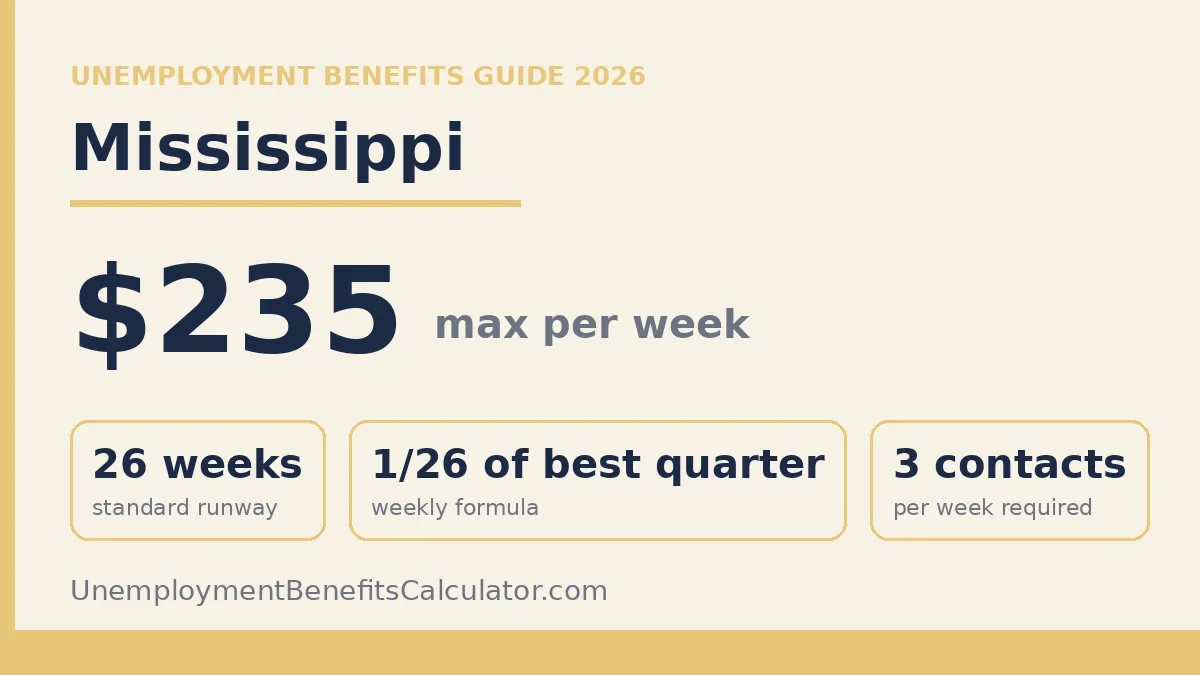
Quick Answer: Mississippi pays one twenty-sixth of your highest base-period quarter, from $30 to a $235 weekly ceiling. A $6,110 best quarter reaches the cap, and 26 weeks at the cap totals $6,110. One unpaid waiting week and three weekly employer contacts frame the claim.
Mississippi prices the weekly check from your single best quarter, up to a $235 ceiling set by state law. The whole claim is capped at 26 times that weekly rate, so the math starts the week you file.
Three things decide the outcome: the wage test, the weekly claim, and the work-search log. This guide walks each one with MDES's current rules. The state comparison table is there for readers weighing Mississippi against its neighbors.
Employers pay the whole cost of the program through their taxes, and the worker pays nothing into it.
| Item | Mississippi 2026 value |
|---|---|
| Weekly formula | One twenty-sixth of the highest quarter, rounded down |
| Minimum weekly benefit | $30 |
| Maximum weekly benefit | $235 |
| Duration | 26 times the weekly rate or one-third of base wages, whichever is less |
| Waiting week | One week, unpaid |
| Work search | At least three employer contacts per week |
| Part-time allowance | First $40 of weekly earnings passes through |
| Appeal window | 14 days from the mailing date |
"$235 Is Not Worth the Paperwork"
The math says otherwise. A claimant at the $235 ceiling collects $6,110 across a full claim, and a mid-range week of $180 still pays $4,680 over 26 weeks.
Against zero income, filing is not a close call, and even a mid-range record beats an empty mailbox.
Take Marcus, a Jackson line cook whose best quarter was $5,200. One twenty-sixth of that quarter is $200, so his weekly check prices at $200.
Run your own quarter through the benefit estimation guide before the letter arrives.
Duration adds a second check on thin records. The package price is 26 times the weekly rate or one third of base-period wages, whichever is less.
A record with $9,000 in base wages caps the claim at $3,000. See the endgame in the benefits-run-out guide.
The wage test comes first. Mississippi applies three gates: work in two base-period quarters, at least $780 in the highest quarter, and base wages of 40 times the weekly rate.
The earnings requirements guide walks both computations side by side.
One Twenty-Sixth of the Best Quarter
The statute is blunt: divide the wages in your highest base-period quarter by 26 and round to the next lower dollar.
A quarter of $5,200 prices at $200, and a quarter of $2,600 prices at $100.
The formula ignores the other three quarters entirely. That design favors concentrated earners over the averaging states in the formula comparison guide.
The floor is $30 and the ceiling $235, a range you can trace on the maximum benefits ranking.
The base period takes the first four of the trailing five completed quarters. A hot recent quarter can sit outside the window until a later claim.
Quarter changes land on the first Sunday of January, April, July, and October. The base period guide maps the timing.
Rounding always runs down. The Monetary Determination letter turns the formula into your file's numbers.
Read it the day it lands. A wage reported late by an employer shows up as a smaller week, a trap the weekly benefit calculation guide explains.
A claim opened in November prices from a different quarter set than a January claim, a shift the base period guide makes concrete.
"The System Is Built to Deny You"
Denials run on triggers, not luck. Most monetary rejections fail the $780 high-quarter test or the 40-times wage rule.
Run the earnings requirements walkthrough before you file. Missed weekly claims and skipped searches make up the other trigger family.
Silence on a fact-finding questionnaire converts a winnable case into a loss, the pattern documented in the employer contest guide.
A misconduct discharge costs more: the bar runs until you return to work and earn eight times the weekly rate in covered work. Inefficiency alone does not meet the misconduct standard.
Separation disputes carry the heaviest paperwork load, and hearings weigh evidence, not stories. Start with the fired guide, the quit guide, and the good cause framework, then narrow your case.
Performance write-ups and attendance files deserve a close read before you assume the employer's version wins. The performance guide covers inefficiency cases, and the absenteeism guide covers the no-show patterns.
Price Your Mississippi Week
One division sets the check: best quarter divided by 26, capped at $235. The Mississippi calculator runs that math for you and flags the one-third cap too.
Open the Mississippi Calculator →Three Employer Contacts, Logged Weekly
Mississippi requires 3 employer contacts every week, and at least one must be a completed application. The work has to be full time, 35 hours or more.
MDES verifies every entry with the employer afterward. Registration comes first: claimants must register for work with MDES Employment Services, and the state can schedule job center appointments during the claim.
The audit happens after you certify, so the defense is a same-day log: dates, employer names, contact methods, and outcomes.
Build it the day each contact happens with the search log guide, and review the standing rules in the work search overview.
Networking events supplement the count but rarely replace direct applications, per the job fair rules. Union members in good standing of a nondiscriminatory hiring hall can meet the standard through the hall's placement services.
The union member guide explains how. A failed week is expensive: MDES denies the week and demands back anything already paid, per the failed requirements guide and the disqualification overview.
The certification questions guide previews what the weekly form asks, and the furlough guide covers layoff and recall scenarios.
"Part-Time Work Ends the Check"
False. Mississippi lets the first $40 of gross weekly earnings pass through with no deduction, and only the excess comes off the check. A claimant pricing at $200 who earns $60 nets $220 for the week.
The teeth come at the top. Earnings above the allowance plus the benefit zero the week, and 35-plus hours end it entirely.
The partial earnings guide shows where Mississippi's flat allowance sits.
Report gross wages during the week the work took place, not in the week the pay arrives. The income reporting guide and the part-time work guide cover the formats.
Deliberate underreporting feeds the fraud penalties in the disqualification overview and the repayment machinery behind the overpayment playbook.
Fraud carries a fixed price: a penalty up to 52 weeks for fraudulent claims, on top of repayment of the gross amount.
File Through mdes.ms.gov Before the Week Closes
Intake runs through MDES's site at mdes.ms.gov. The contact center at 601-493-9427 takes live calls Monday through Friday.
File the week work stops. Claims usually start the Sunday of your filing week. The MDES regulations allow limited backdating only with good cause.
Arrive with your Social Security number, the 18-month employer list with addresses, separation dates and reasons, and bank details for deposit.
The checklist in the pre-filing checklist prevents the return-for-more-information loop, and the online application guide covers timing.
After intake, the Monetary Determination letter prices the week and lists every employer in the wage record.
Read it against the math in the weekly estimator, because a transposed wage is fixable in week one and expensive later.
The post-filing sequence runs through the post-filing timeline, and status checks run from the status guide.
Expect the first check after the second weekly certification clears. The first week serves as the waiting week.
Payment timing follows the weekly rhythm. Delays cluster around a late fact-finding answer or an employer protest.
The payment delay guide covers both recovery paths, and the payment methods comparison weighs deposit against card.
Log the 14-Day Appeal Clock Early
An appeal of an initial or amended determination must be filed within 14 days of the mailing date. The MDES appeals process page repeats the window for both claimants and employers.
File by phone at 1-866-633-7041, at a WIN Job Center, or by signed letter to the Appeals Department.
Keep certifying every week during the appeal. Continued weekly claims preserve your rights for the weeks a win would fund.
The appeal-prep sequence in the denial appeal guide opens the day the letter lands.
Build the case around documents: separation paperwork, schedules, messages, and pay records. The hearing preparation guide shows how to organize them.
Overpayment determinations ride their own track, and the repayment options sit in the overpayment playbook.
Payment delays during an active claim follow the triage path in the payment delay guide, not the appeal track.
A judge's written decision usually arrives within 14 days after the hearing.
The Waiting Week and the Calendar
Mississippi claims start with 1 unpaid waiting week. MDES states the rule flatly: you will not be paid for that week.
Certify anyway, because timely weekly claims are a standing condition.
The waiting week guide compares how states treat that first week, and the certification deadline guide covers missed-week recovery.
Money starts moving after the second weekly claim clears, so the calendar holds one extra week at the front. Weeks run Sunday to Saturday.
The certification walkthrough keeps the streak alive, and the phone certification rules cover the phone option.
At the cap the claim still pays $6,110 in full. The waiting week delays the first check rather than shrinking the package.
The 1099-G and the Tax Layer
Benefits count as taxable income on the federal return, and MDES mails Form 1099-G each January with the year's total.
You may elect 10 percent federal withholding, a choice worth making at filing rather than by default.
The election math, quarterly estimates, and April consequences run through the unemployment tax guide.
Severance or vacation pay in the same season changes the reporting picture. The severance reduction guide covers the interactions.
Payment delivery runs via direct deposit or the state's debit card, compared in the payment methods guide.
Pension offsets, Social Security, and lump sums follow the patterns in the pension guide, the Social Security walkthrough, and the one-time payment explainer.
Pensions from base-period employers can reduce benefits. Social Security does not count against the claim. The letter shows how a reduction lands week by week.
Test the One-Third Cap Before You File
Mississippi caps the whole claim at one third of your base wages, and thin records hit that limit first. Enter your quarters and see which cap binds.
Run the Mississippi Calculator →Your Mississippi Action List
File the claim the week work stops through mdes.ms.gov, with the 18-month employer list and banking details in hand.
Read the Monetary Determination the day it lands, and correct any wage error while the claim is still new.
Start the work-search log from day one using the search log guide. Certify each week inside the deadline including the waiting week, per the certification walkthrough.
Report every dollar above the $40 allowance. Answer fact-finding questionnaires the week they arrive. Calendar the 14-day appeal window with the hearing guide as your template.
If the wage record crosses state lines, the state comparison table shows what neighboring programs pay, and the training guide covers school exceptions mid-claim.
A Mississippi claim pays what the statute priced, and the filer who certifies weekly and searches in threes collects all of it.
Frequently Asked Questions
What will Mississippi unemployment pay each week in 2026?
The weekly check runs from $30 to a $235 cap: one twenty-sixth of your highest base-period quarter, rounded down. A $5,200 quarter pays $200, and the cap starts at $6,110 in that quarter. The maximum package totals $6,110 over 26 weeks.
How does Mississippi compute the weekly benefit amount?
The state divides your highest quarter of base-period wages by 26 and rounds the result down. No other quarter changes the figure. A $2,600 quarter prices at $100 per week, and the $235 ceiling starts at $6,110.
How long can a Mississippi claim pay benefits?
A claim pays no more than 26 times your weekly rate or one third of your base-period wages, whichever is less. At the $235 cap that is $6,110 over 26 weeks. Thin wage records hit the one-third limit sooner.
Does Mississippi have a waiting week before checks start?
Yes. The first eligible week on a new claim is an unpaid waiting week, and MDES pays nothing for it. Certify anyway, because timely weekly certification remains a standing condition for every week of the claim.
How many employer contacts does Mississippi require weekly?
Three employer contacts each week, and at least one must be a completed application. The work must be full time, 35 hours or more, and suitable for your skills. MDES verifies details with employers, so keep a dated log.
What is the deadline to appeal a Mississippi decision?
File within 14 days of the mailing date, by phone, at a WIN Job Center, or by signed letter to the Appeals Department. Keep certifying during the appeal so those weeks stay payable if you win.
Can I work part-time and collect Mississippi unemployment?
Yes. The first $40 of gross weekly earnings passes through untouched, and only the excess reduces the check. A $200 rate with $60 earned nets $220. Earnings above the allowance plus the benefit zero the week.
Does Mississippi send a 1099-G for unemployment?
Benefits are taxable on the federal return. MDES mails Form 1099-G each January with the year's total, and you may elect 10 percent federal withholding. Without it, schedule estimates so the April bill stays manageable.