
The answer first, because Minnesota's program is simple enough to state plainly: unemployment here pays roughly half of the wages you averaged per week, capped at $983, for up to 26 weeks, with no waiting week, a minimum of one documented employer contact per week, a 20-day appeal window, and taxable benefits at both the federal and Minnesota level. A Bloomington warehouse lead earning $1,900 a week would land near $950, just under the cap. (Minnesota Unemployment Insurance / DEED, checked October 27, 2026)
That makes Minnesota one of the strongest weekly programs in the country and one of the lightest to maintain, a combination the Midwest neighbors cannot match. The claim below runs in steps, from the application through UIMS to the last deposit, because Minnesota's process rewards doing six specific things in the right order and punishes almost nothing else.
| Item | Minnesota 2026 value |
|---|---|
| Maximum weekly benefit | $983 per week |
| Minimum weekly benefit | $38 per week |
| Formula | About 50% of your average weekly wage |
| Standard duration | Up to 26 weeks in a 52-week benefit year |
| Waiting week | None, the first eligible week pays |
| Work search | At least 1 documented employer contact per week, plus registration |
| Appeal window | 20 calendar days from the mailing date |
| State tax on benefits | Yes, Minnesota income tax applies; withholding by election |
Do Your Wages Clear the Monetary Test? Step 1
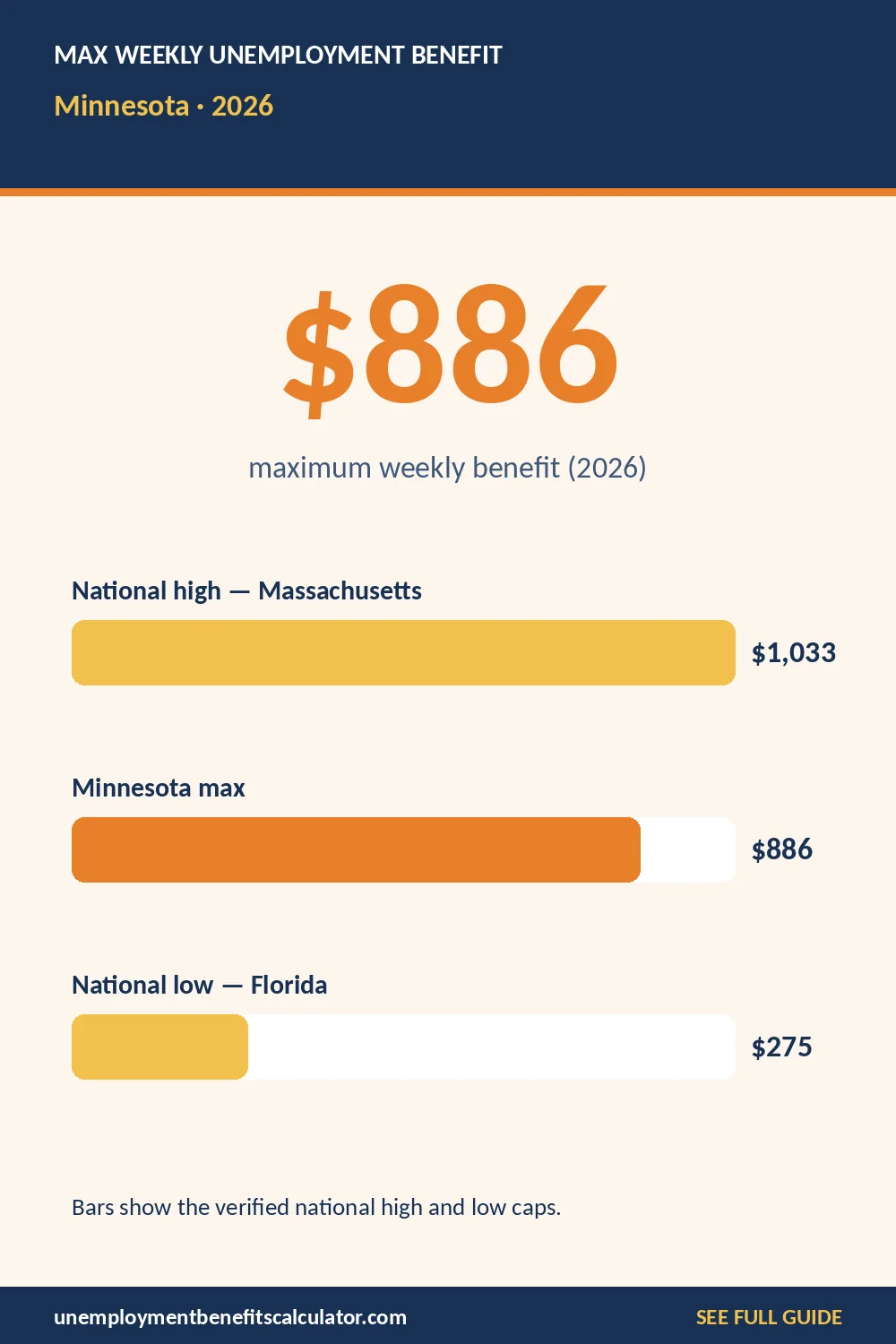
Minnesota builds the account from base-period wages reported by covered employers, applies the half-replacement formula, and floors the result at $38. The warehouse lead's steady two-year history priced near $950; a seasonal construction worker with one strong summer quarter prices lower but still payable. Wages from 1099 work and self-employment do not feed the formula, and the monetary eligibility breakdown lists what counts. The agency adjusts the ceiling every October, which is why the current figure reads $983 rather than the $948 or $886 quoted in older material, and the calculation walkthrough reproduces the math before the determination letter does.
Border workers should pause here. Minnesota pays far above Wisconsin's $370 ceiling and above the Dakotas' programs, and the claim files where the work happened. A Fargo resident employed by a Moorhead employer files Minnesota rules, and the interstate-claim guide explains how the wage combination works when the history spans states.
Apply Through the Online System in One Sitting, Step 2
The application runs through the state's online self-service system and takes most claimants 30 to 45 minutes: employer history for the last 18 months, separation reasons, and the final pay stub. The warehouse lead had all three ready, and the pre-filing checklist matches the screens line by line. File the week the work ends, because Minnesota charges no waiting week and each idle week ahead of the filing date is a payable week thrown away.
The determination of benefit account arrives by mail and in the online portal, stating the weekly amount, the maximum pot, and the wage credits used. Read it against your own math the day it lands, because Minnesota corrects wage errors quickly inside the appeal window but slowly outside it. Missing wages from a short-lived job are the most common complaint, and the final pay stub plus the last W-2 usually settle them in one phone call. The post-filing timeline guide sets expectations: first payment typically two to three weeks after a clean filing, among the faster turnarounds in the region.
Account security belongs in the filing step too. Minnesota's UI system has been a favorite target of credential-stuffing scams, the agency never asks for passwords by phone or email, and a locked account in week one is a claim paid in week five. The claim-status guide covers the legitimate paths into the system, and treating the login like a bank login is the whole defense.
When Does the First Payment Land?
Minnesota pays among the fastest first checks in the region, and the warehouse lead's money arrived early in week three, with the waiting-week absence doing exactly what it was designed to do. Payments run by direct deposit or a prepaid card, elected inside the application, and the payment-method guide compares the two on fees and timing. The first-payment timeline guide sets the expectation for every stage between filing and deposit.
What slows a Minnesota claim is rarely the program itself. Wage mismatches against employer reports, a pending identity check, or an employer contest account for nearly every stalled first payment, and the delayed-payment guide sorts those causes in the order they actually occur. The fix window matters: a wage discrepancy answered in week two is a correction, while the same discrepancy discovered in week six is an appeal.
Register and Log One Employer Contact a Week, Step 3
Minnesota's weekly search duty is the lightest in its neighborhood: at least one documented employer contact each certified week, with registration in the state's job-search system attached to the claim. Contact means substance rather than a form submission, so a conversation or an application with a named employer counts and a mass-posting click does not. His own routine logged the one contact every Tuesday morning and never gave the rule a second thought. The log-format guide shows the record that survives an audit, and the failed-search guide explains how weeks get reversed when the certification answers cannot be backed.
Light does not mean optional. The one-contact rule is enforced through the certification answers, a week claimed with no search behind it is an overpayment waiting to be noticed, and claimants who prefer structure can count eligible networking toward the duty where it applies. The networking guide sorts which events qualify.
Certify Weekly and Report Part-Time Gross, Step 4
Certification asks the standard four: did you work, what did you gross, were you able and available, and did you log the search. Minnesota lets you earn up to half your weekly benefit amount in a week before the reduction starts, so a claim at the $983 ceiling tolerates about $491 of part-time earnings untouched, and the warehouse lead's snow-removal side jobs in January never touched his check. The disregard breakdown runs the arithmetic, and the part-time claiming guide shows how reduced weeks coexist with the 26-week allowance.
Gross pay belongs in the week the hours happened, not the week the deposit arrived, and the wage audit enforces exactly that. Employer reports arrive quarterly with the exact week-by-week split, so the truth is always checkable on their side. The reporting guide covers the edge cases, and the missed-deadline guide explains why a skipped certification costs the week itself rather than delaying it.
Know What Reduces or Freezes a Check, Step 5
Three things shrink Minnesota checks in practice. Employer contests freeze payments while adjudication compares accounts, and the contest guide explains the evidence that resolves fastest. Pensions from base-period employers offset the weekly amount, and severance packages can delay the claim's start, both covered by the pension guide and the severance guide. Certification errors harden into overpayment notices, and the overpayment guide lays out the response options before notices age into collections.
Corporate layoffs like the warehouse restructure arrive with one extra wrinkle: vacation payouts and bonus allocations can attach to specific weeks and reduce them, and the lump-sum guide shows the allocation mechanics so the first reduced week does not come as a surprise.
What About Shared Work and Employer Programs?
Minnesota's shared-work program gives employers the alternative the warehouse never needed: cut hours across the crew instead of cutting heads, with partial benefits filling the wage gap for the affected employees. Seniority and health coverage hold through the trough, and the shared-work guide covers the setup from both sides. Workers handed a reduced-schedule offer should read the reduced-schedule guide before declining hours, because the refusal reads differently at adjudication than it feels in the moment.
Work-sharing aside, the program interacts with a handful of employer-side situations worth flagging: plant closures that pay out vacation in lump sums, ownership transfers that complicate wage records, and seasonal callbacks that straddle the benefit year. The lump-sum guide and the furlough guide cover the two most common, and both read faster before the payout lands than after.
What If a Determination Reads Wrong? Step 6
Minnesota allows 20 calendar days from the mailing date to appeal any determination, from the monetary amount to a full denial. Appeals go first to an unemployment law judge by phone, with documents doing most of the winning. The appeal itself was unremarkable: a missing quarter of wages from a staffing-agency stint, a corrected determination, and a hearing that never needed to happen once the pay stubs landed. The appeal walkthrough and the hearing guide describe the packet, and the disqualification guide previews which separations need which proof.
Keep certifying through any appeal, because only weeks certified on time can be paid retroactively after a win, and the benefit-year clock keeps running whether or not you file weeks underneath it.
Do School Employees and Federal Workers File Differently?
School employees do, and the difference catches riders, aides, and custodians every June. Between-term breaks carry a reasonable-assurance question, so a claim for a scheduled summer week fails no matter how the paperwork reads, and the between-year gap needs its own analysis. The school-employee guide maps which weeks can pay, and the warehouse lead's neighbor, a district paraprofessional, used it to time a claim that survived adjudication intact.
Federal workers file under a mixed program that pays through the state with federal funding rules attached, and the transition after an agency reduction has its own sequence. The veterans guide and the federal-employment sections of the qualifications guide cover the credential paths. Both groups share one lesson with everyone else: the base-period rules decide the money, and reading them before filing beats disputing them after.
$25,558: The Number a Full Minnesota Run Produces
Twenty-six weeks at the $983 ceiling totals $25,558, and mid-wage claims in the $600 to $900 band finish between roughly $15,000 and $23,000. That total is why Minnesota claims change household math in ways neighboring programs do not, and it is also why the tax layer deserves a week-one decision: at the ceiling, benefits add about $983 a week to the income the IRS and Minnesota both tax. The warehouse lead treated the number as a budget ceiling rather than a windfall, which is the posture the April return rewards. The tax guide works the withholding elections, and the January 1099-G feeds both returns.
Where the ceiling sits regionally: Wisconsin's $370 max, Iowa's and the Dakotas' lower bands, and Illinois' higher program frame Minnesota as the strongest weekly payer in its immediate set, which the comparison guide and the maximums table quantify across all fifty states.
When Do Extended Benefits Trigger?
Standard Minnesota benefits end at 26 weeks, and the extensions beyond that are trigger-based rather than automatic favors. Extended benefits activate when the state's unemployment rate crosses statutory thresholds, and the on-off history of those triggers explains why older guides promise weeks the current program does not run. The trigger guide tracks which programs are live, and the extension guide explains the phasing when one activates.
Mid-claim relocation deserves the same early read. A Minnesota claim continues on Minnesota rules after a move, with the weekly answers and availability questions updated through the portal, and the relocation guide covers the notification sequence. Moving across the river to Wisconsin does not convert the claim, and the interstate guide explains why the wage history, not the new address, decides which program pays.
What Minnesota's Program Cannot Do
Honesty section, because strong programs breed strong assumptions. A $983 check assumes a qualifying wage history, and claimants with thin or contractor-heavy years will price far lower or open nothing at all, which the self-employment guide and the thin-history guide explain. The program will not run for claimants separated for provable misconduct or who resigned without good cause belonging to the employer, and those are adjudication outcomes, not filing outcomes. School employees face between-term rules entirely, covered in the school-employee guide.
And one limit of this guide itself: the ceiling moves every October, the figures here are verified as of October 27, 2026, and a claim filed after the next adjustment should re-check the cap before any planning math uses it.
What Happens if the Agency Says You Owed Money Back?
Overpayments in Minnesota usually begin as small certification arithmetic: a gross figure entered from the wrong week, a side job reported a week late, or an availability answer that the employer's records contradict. The agency recalculates, sends a notice, and starts a clock that runs separately from the benefit year, and the balance collects attention the longer it sits. A coworker at the same warehouse ignored one of those notices for four months, and the recovery eventually attached to a future claim, which is the outcome the response options exist to prevent. None of it had to happen, because the notice came with paths and the paths came with deadlines.
The notice itself lists repayment, appeal, and waiver paths, and the choice among them is time-sensitive rather than permanent. A waiver based on financial hardship exists, but it needs documentation the first week provides more easily than the sixth. The overpayment response guide walks the three paths with the deadlines attached, and the certification-mistakes catalog shows which errors generate these notices most often, which is the cheaper thing to read by far.
Fraud-adjacent errors sit in a different category entirely. A knowingly false certification is not a paperwork slip, the penalties attach to future eligibility as well as the balance, and the fraud-penalties guide draws the line between the two in plain terms. The distinction matters most in weeks with side income, where rounding habits and reporting habits decide which category a mistake lands in.
The Six-Step Checklist, Compressed
- Confirm base-period wages clear the monetary test and price your weekly estimate first
- Apply through the online system the week the work ends, employer history ready
- Read the determination of benefit account the day it arrives and check the math
- Register for job-search services and log one employer contact every certified week
- Certify weekly, reporting gross wages for the week the work happened
- Calendar the 20-day appeal window and elect withholding deliberately in week one
The warehouse lead worked the six steps in order and his claim ran 26 weeks without a single flag, which is the ordinary result in a program built for exactly that kind of compliance. Minnesota asks little weekly and pays much weekly, and the gap between the two is where most claim problems live. Run the checklist while the layoff is fresh, and when any rule seems to have moved, cross-check it against the federal UI directory before relying on it.
Frequently Asked Questions
How much is unemployment in Minnesota in 2026?
Roughly half of the wages you averaged per week, capped at $983, with a low state-set minimum floor. The cap adjusts every October, which is why current figures read $983 rather than the $948 or $886 quoted in older guides. A full 26-week run at the ceiling totals $25,558 before taxes.
Does Minnesota have a waiting week?
No. Minnesota pays from the first eligible certified week with no unpaid week at the front of the claim. First money typically arrives two to three weeks after a clean filing, and none of that processing time consumes the 26-week allowance, which is why filing the week work ends matters so much here.
What are Minnesota's work search requirements?
At least one documented employer contact every certified week, with registration in the state's job-search system attached to the claim. It is the lightest weekly duty in the neighborhood, but it is enforced through certification answers, and weeks claimed without a backing record can be reversed with an overpayment attached.
How much can I earn and still get Minnesota unemployment?
Minnesota ignores earnings up to half your weekly benefit amount before the reduction starts, so a claim at the $983 ceiling tolerates about $491 of weekly part-time pay untouched. Enter gross pay under the week the hours happened, and a week whose gross climbs past your weekly amount pays nothing while still counting as certified.
Does Minnesota tax unemployment benefits?
Yes, at both levels. The IRS counts benefits and Minnesota taxes them as state income. Withholding runs by election rather than automatically, so the federal 10 percent election and a manual reserve for the Minnesota layer is the standard week-one decision, and the January 1099-G feeds both returns.
How many days to appeal a Minnesota unemployment decision?
20 calendar days counted from the determination's postmark, whether it concerns the monetary amount or a full denial. Appeals go to an unemployment law judge by phone, and document-backed cases win far more often than argument-backed ones. Keep certifying during the appeal so a win pays the certified backlog.