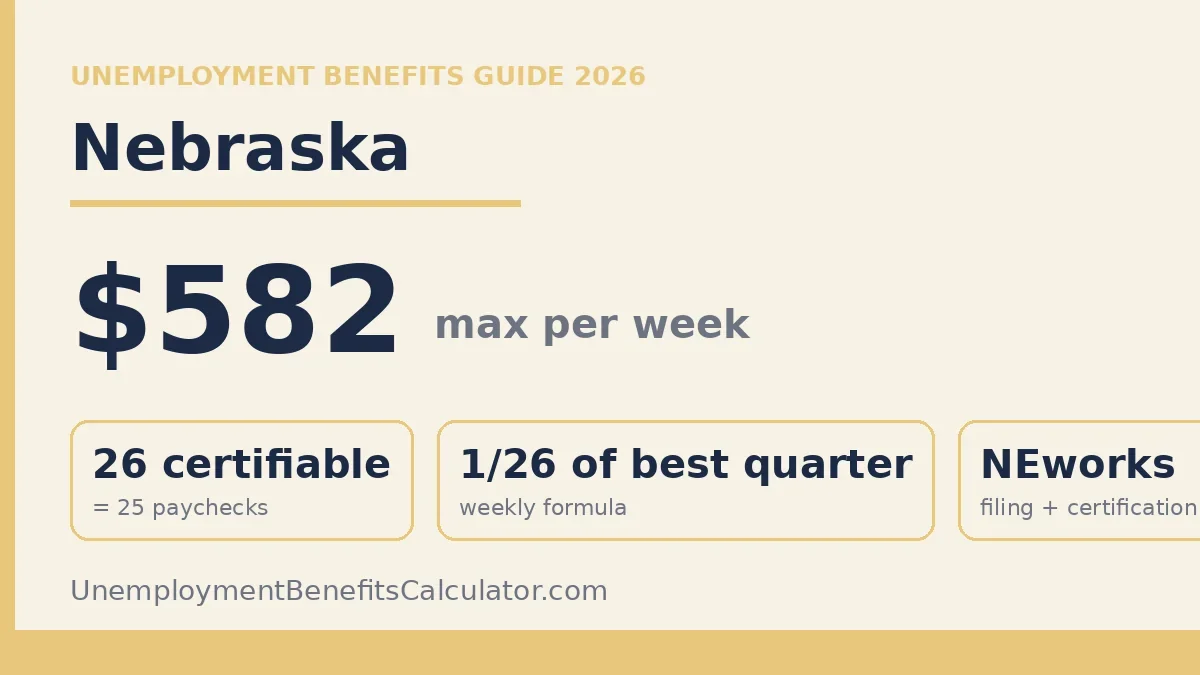
Quick Answer: Nebraska takes your highest base-period quarter over 26, from a $70 floor to a $582 ceiling. Claims pay up to 26 weeks after the unpaid waiting week, and five reemployment activities are due weekly. Certify on time and price the claim before the letter arrives.
Nebraska pays half of the weekly wage your best quarter produced, between $70 and $582, for a claim that runs up to 26 certifiable weeks and turns into 25 paychecks because the front week is an unpaid waiting week.
And the weekly rhythm runs through NEworks, the state's filing and certification platform.
That is the direct answer. And the sections below solve the problems that actually cost Nebraskans money.
Quarters that price lower than expected, waiting-week missteps, search-log failures.
And part-time math that eats checks. Each section pairs the rule with the fix.
And the links throughout open every rule in full, the estimator inside leading the list the benefit estimation guide and the full cross-state table in the state comparison.
| Item | Nebraska 2026 value |
|---|---|
| Weekly formula | Half the weekly wage of the highest quarter (one twenty-sixth) |
| Minimum weekly benefit | $70 |
| Maximum weekly benefit | $582 |
| Standard duration | Up to 26 certifiable weeks |
| Waiting week | One week, unpaid (25 paychecks) |
| Work search | NEworks registration plus five reemployment activities per week |
| Appeal | The determination letter states the window |
The One Twenty-Sixth Answer
The direct answer to the money question. Divide your highest base-period quarter by 26, clamp the result between $70 and $582.
And that is the check.
An Omaha freight coordinator with a $15,132 top quarter prices at the full $582, a Lincoln hospital tech with a $9,880 quarter prices at $380.
And a Grand Island packing-house worker with a $6,500 quarter prices at $250. The division pays half of the top quarter's weekly run rate.
That makes Nebraska kinder to concentrated earners than the averaging states compared in the formula comparison guide.
The ceiling takes over above a best quarter of $15,132. And the $70 floor catches the thinnest qualifying records.
So the range runs narrower than the national spread in the maximum benefits ranking. Two structural notes follow from the answer.
The base period is built from the four earliest quarters of the trailing five, mapped by calendar inside the base period guide.
The division rounds within the schedule's own rules.
That the worked examples in the calculation guide illustrate.
The formula's edge cases are where the surprises live. A claimant whose two best quarters sit within $100 of each other gets the same check either way, which makes quarter-chasing pointless for even earners.
That is the entire point of pricing the claim first.
Price the Claim Before the Letter Arrives
The first problem this guide solves is surprise. A determination letter that lands $100 under what the claimant expected.
Because a stronger quarter sat outside the window or a wage went unreported. The fix is pre-filing arithmetic.
Pull the quarterly wage statements, run the division against the estimator in the weekly estimator. Compare against the wage-test walkthrough from the earnings requirements guide before the application opens.
Claimants with thin or one-sided records face the surprise most often.
And the recovery options sit in the no-work-history guide and your low-wage scenarios in your minimum wage guide.
Seasonal workers whose best quarter trails the window by weeks should read the seasonal workers guide, because filing date shifts the whole window and sometimes the whole claim.
The wage tests behind qualification deserve their own pass. Nebraska requires covered wages spread through the base period and enough earnings for the division to clear the $70 floor.
And a claim that fails both is where the honest conversation about requalification wages begins, per the qualification overview.
File the Week Work Stops
In 2026, the second problem is calendar drift. And the remedy is a one-week rule.
File the claim the week work stops, through NEworks.
Because the claim's start date is that filing week's Sunday and nothing backdates.
And account details for deposits for direct deposit, a checklist mirrored in the pre-filing checklist and the filing sequence in the online application guide.
Keep the separation story exact and consistent with what the employer reports. Because mismatches trigger the fact-finding reviews covered in the post-filing timeline.
Anyone leaving alongside a package should clear the severance overlap in the severance guide before intake pins the answers.
And furloughed workers with a recall date should scan the furlough guide for the modified search duties.
The first days after filing set the claim's temperature. Because incomplete employer data is the most common cause of processing loops.
The filing-day sequence is short, and the walkthroughs above keep it that way.
Convert the Waiting Week Into Twenty-Five Checks
In 2026, the third problem is the waiting week. That claims a check from every Nebraska claim and catches claimants who budget on twenty-six.
The fix is deliberate certification: file for that first week like any other, on schedule. Because the streak of certifications is what keeps the runway intact.
And the waiting week converts to payment at exhaustion for claimants who run the full claim, the mechanic set side by side in the waiting week guide.
The budget math follows. 26 Certifiable weeks, 25 paychecks.
And a maximum package of $14,550 at the $582 cap before the waiting week adjusts it.
Certifications run weekly through NEworks with the discipline described in the certification guide, the phone fallback in your phone certification rules, and the deadline trap documented in the missed deadline guide.
The waiting week also sets the compliance tone. And three habits carry through the rest of the claim.
And the phone fallback covers portal outages.
But neither restores a week lost to silence.
Price Your Nebraska Week
Your best quarter divided by 26 is the whole formula, clamped between $70 and $582. The Nebraska calculator prices it before the determination letter does.
Open the Nebraska Calculator →Build the Contact Log From Week One
In 2026, the fourth problem is the search-log audit. That lands after the fact as denied weeks plus overpayment demands.
The answer is documentation from the first certified week.
NEworks registration completed at intake, five reemployment activities recorded weekly with dates, names. And outcomes, the examples ranging from job fairs to employer calls.
And the log kept in the formats that survive review, templated in the search log guide.
The requirement itself is outlined in the work search overview. Job fairs count only inside those definitions, per the networking rules.
The failure patterns are cataloged in the failed requirements guide. The certification answers that report search activity carry fraud-law weight, a line the disqualification overview draws.
Union hiring hall members follow the hall's dispatch rules per the union guide. Claimants in approved training substitute program participation per the school rules.
The audit itself is a records request, not an interrogation. The department asks for the log covering specific weeks, compares it against the certifications.
And looks for the three failure patterns, fabricated entries, recycled employers. And activity types outside the definitions.
A log built the day each contact happened survives all three probes. Claimants who discover a gap mid-claim rebuild going forward and say so plainly if asked.
Because honest thin weeks read better than rich fiction. And the distinction matters at the fraud boundary drawn in the disqualification overview.
What Does Part-Time Work Pay?
In 2026, the fifth problem is part-time math that eats checks in the states with no disregard.
Gross wages for the week report on the certification in the week the work happened, with the formats from the part-time income guide and a careful read.
And the deduction ladder from state to state is drawn in the part-time reduction guide plus the partial earnings explainer.
A worked week shows the mechanics. A $380 check with ten hours at $15 gross reports $150: the week pays $230, certifies as partial, and the balance preserves.
The same claimant who picks up a $500 bonus that week reports it and watches the week zero out, since the allocation rules charge lump sums to the payment week, not the earning quarter.
The reporting formats are identical either way. That is the quiet advantage of the weekly certification system described above.
The edges matter as much as the middle. And refusing suitable offers starts the review covered in the refusal guide.
Claimants weighing freelance income should study the business rules ahead of invoicing, since self-employment reports differently than wages.
Answer the Determination Fast
In 2026, the sixth problem is the determination that goes unchallenged past its window. Every determination letter prints the appeal instructions and the deadline that governs it.
So mark the date the day the letter lands and file through the stated channel, with the preparation sequence within the denial appeal guide and the hearing format in the hearing prep guide.
Keep certifying weekly through the appeal. Because the weeks kept certified are the ones a win converts to payment.
Employers contest separations on their own track.
And their burden sits with the employer contest guide, the firing patterns in your fired guide and the performance guide, and the quit tests in the quit guide with the good cause rules in the good cause explainer.
Overpayment determinations follow their own repayment machinery in the overpayment playbook.
Preparation beats persuasion at the hearing stage. Rehearse the timeline once, in plain sentences.
And stop at the end of each answer rather than filling silence.
Because the record belongs to the referee and the silence belongs to you. The hearing formats vary by state but the discipline does not.
That is why the preparation guide above travels across every claim in this series.
The 1099-G and the Money Layer
Taxability starts at the federal level, where the 1099-G carries the annual total. And withholding runs on election rather than by default.
The filing-season mechanics, from the withholding decision to quarterly estimates, live inside the unemployment tax guide. Payment delivery through direct deposit or the prepaid card is compared in the payment methods guide.
Payment delays follow the triage in the delay guide, and status checks live in the status guide.
The 1099-G season rewards the claimant who kept the withholding election deliberate. A full 26-week claim at the $582 cap produces a five-figure annual total.
The election adjusts mid-claim, the quarterly-estimate path exists for claimants juggling other income. Claimants who moved mid-claim should confirm the mailing address before January.
Because the 1099-G follows the file, not the person. And a lost form delays nothing except the refund.
Pension offsets, Social Security interactions.
And lump-sum treatment echo the patterns in the pension explainer, the Social Security explainer, and the one-shot payment guide.
Each shifts which weeks carry charges.
So verify the interplay before the withholding election locks. And on time.
And that record is built week by week from the first certification forward.
Plan the 26-Week Runway
A quarter above $15,132 touches the ceiling, and the waiting week turns 26 certified weeks into 25 checks. Enter your wages and see the full package before filing.
Run the Nebraska Calculator →Where a Nebraska Claim Goes From Here
In 2026, start with the filing sequence in the application walkthrough and the certification discipline in the mistakes guide, then handle the specific wrinkles.
The interstate question in the interstate rules, the relocation question in the moving guide, and the exhaustion options in the benefits-run-out guide plus the extension triggers in the extension guide.
Claimants with dependent questions should read the dependents guide, teachers and school staff the between-term rules inside the school employees guide.
Temp-agency workers the naming convention in the temp agency guide.
A Nebraska claim rewards the claimant who runs the division early, certifies without gaps. And treats the 25-paycheck year as the budget it actually is.
The schedule leaves no room for improvisation. That is exactly what makes it navigable.
Frequently Asked Questions
What will Nebraska unemployment pay each week in 2026?
Nebraska divides your highest base-period quarter by 26 and clamps the result between $70 and $582, the 2026 maximum confirmed by the Department of Labor. A quarter of $9,880 prices at $380, and a quarter above $15,132 prices at the full ceiling.
How does the Nebraska formula treat my other quarters?
Only the highest quarter feeds the division, which pays about half of that quarter's weekly run rate. The other three quarters never change the check, so overtime-heavy months set the rate for the whole claim.
How long do Nebraska unemployment benefits last?
Claims pay up to 26 weeks during a 12-month period, the maximum the Nebraska Department of Labor states. The waiting week consumes the first certifiable week, so a full claim pays 25 checks across the runway.
Does Nebraska have a waiting week?
Yes. Nebraska law makes the first week after you file an unpaid waiting week, and you must still file a weekly claim for it. Skip that certification and every later payment slides back a week.
What are the Nebraska work-search requirements?
Nebraska asks for five reemployment activities each week, with examples that range from attending a job fair to calling employers. Register through NEworks, keep dated entries for every activity, and treat five as a weekly floor.
Can I work part-time and still get Nebraska unemployment?
Yes. Gross weekly wages deduct from the weekly figure, and the week certifies as partial while earnings stay under your benefit amount. A $380 check with $150 of wages reports the earnings and nets $230.
How do I appeal a Nebraska determination?
Answer the determination fast, because the letter states the appeal window that governs your case. Hearings run on a formal record, so build the file around the termination letter and the pay records rather than argument alone.
Are Nebraska unemployment benefits taxed?
Federal law taxes benefits as income, and the 1099-G arrives each January with the annual total. Nebraska withholds federal tax only when you elect it, so treat the election as a monthly budget line rather than an April surprise.